A homily for Imbolc and the Full Moon on February 1, 2026. Written, as always, without authority.
Dearly Beloved,
Blessed Imbolc, dear ones, and blessed Full Moon. I greet you in the name of Aphrodite and the name of the Divine on this, the Full Moon of Aquarius and Imbolc of 2026.
Imbolc is special to me.
But I get ahead of myself in my eagerness. Let me slow down.
As I mentioned in my New Moon homily last month, I am not okay. The Long Night is wearing on me already and it’s barely begun. ICE has murdered at least 9 people this year and they murdered at least 32 people in 2025. They will almost assuredly murder more. And these numbers do not include what is happening behind locked doors at the ICE detention facilities. I also expect that, just like the German people after WWII ended, we will eventually find out that mass murders and torture have been taking place (and being paid for by our tax dollars) the whole time. Future historians will almost certainly reveal that, despite the fact that the lights stayed on and the internet kept us “connected”, the Long Night was dark indeed.
My calling as a priestess of Aphrodite requires certain things of me. Most of the time the burden is light. I focus on the magick and mysticism of love and relationships, joy and beauty, and yes, sexy time, too. And I wouldn’t have it any other way, truly. I love Aphrodite dearly and serve Her gladly. But in moments like this, the sheer intensity of reality is hard to bear. Every death and every collision between the people of my country (our country) and our government (my government) that results in suffering breaks my heart.
Now, I don’t have a theological problem with suffering like some people do. I had to work that out when I got sick. I had to face that sense of betrayal that comes from having “followed the rules” and “gotten punished” anyway. That was a long time ago. I confronted my internalized ableism, worked my way through it, and came out with clearer and stronger beliefs. I have come to believe that suffering is natural. But not only is it natural, it is also a reasonable outcome of the reality we live in.
I not only believe in the naturalized theology that I have spoken of many times, but I also believe that reality is fundamentally multipolar and polyvalent, which means there are many different entities that are each causing change in many different ways at any given moment. While I do believe that there is a single transcendent and unified ground of all being upon which all of reality depends (which I call the Divine or Chaos, depending on how I feel about reality at the moment), I also believe that here on the levels of existence where most of human life takes place, polytheism is (mostly) true. I also believe that deities are not exactly good in the ethical sense that most humans mean the word. They are Themselves, and They are the Good, the True, and the Beautiful in relation to their domains. This accounts for the, shall we say, moral flexibility and diversity of agendas exhibited by deities when spoken of from the point of view of humans. Deities can be cruel, as Athena was to Arachne. They can play favorites, as Aphrodite did with Adonis. They can be mischievous, as Hermes was with the herds of Apollo. And sometimes, tragically, They can do far worse, as both Ouranos and Cronus did to Their children and Their children in turn did to Them.
In short, I believe that deities (and spirits) are people, with all of the complexities, passions, and nuances of people. This means that I don’t need a pagan theodicy—an answer to the “Problem Of Evil”—or a divine justification for the existence of suffering. Evil and suffering happens because there are all sorts of different people—humans, spirits, deities, fae, whatever—with varying levels of power to cause change. All of us all have diverse natures and agendas, and we are all pursuing our own goals as best we can and for our own reasons. All of this happens in a reality that has certain rules baked in, established and maintained by the Primordials such as Ananke (Necessity), Chronos (Time) and the Moirai (the Fates). This means that just like how friction exists because the conditions of existence naturally creates it, so too does suffering, and neither of these facts are because anyone is out to get us or because we did something wrong. It is just life, and life is a rough game, often played for keeps.
So when I witness suffering in the world or experience suffering myself, it doesn’t make me question the existence of deities or the value of my relationships with deities. The proof is in the pudding, and my gods treat me very well. But suffering does make me look for ways to grow, and a big part of why I think that way is because of the only deity outside the Greek pantheon with Whom I have a personal relationship: Brigid.
Now I can say it: Imbolc is special to me. Very special.
Longtime readers of Without Authority may remember that my very first homily was for Imbolc, 2024. It was a big step outside of my comfort zone. I had only been publishing my poetry and philosophical work before that, which had given me some distance, some buffer, between my heart and the frankly terrifying eyes of the reader. I could just present my poetry with no explanation or need to engage, and my philosophical work had all of the cultivated distance that my academic training could grant. Sometimes the poetry was scarily intimate, but I didn’t have to actually talk about it after I posted it, so it felt safer. But writing a homily, bringing my work as a priestess out of strictly ritual contexts among my own spiritual community and into the general public, required something new of me, a type of openness that I had never experienced before. So I asked my goddess Aphrodite what to do, what to say, and for the very first time She told me the words She has repeated again and again over the last two years:
“Lead with your vulnerability.”
So I chose Imbolc for my first homily because, as I said, Imbolc is special to me. And I want to tell you why, but like a lot of my homilies, it is scary. I don’t generally tell this story because it isn’t very flattering. In fact, I don’t think I have ever told it to anyone except my wife and my former best friend and business partner, Birch. But my goddess is telling me “Do it, bitch!”, so here we go.
When I was 14 years old, I moved back to Victoria, Texas to live with my grandparents again after attempting to live with my Mother, stepfather, and my little brother full-time for the first time ever. It had not gone well and I was willingly returning to my own abusers because, frankly, it seemed better than being around my Mother and living in Austin. Partially that was because my Mother and I don’t really know how to have a functional relationship, but part of it was also because some girls I went to school with were brutally murdered at a yogurt shop and it really freaked me out. Let me be clear: this wasn’t a healthy decision and it cost me dearly, but it was the only decision that felt available to me at the time.
When I got back to my hometown, I had lost all fear of my peers. I’m not sure what flipped the switch, but it happened. I still didn’t trust them and I thought most of them were dangerous, but I was teetering into a bad place where I really just didn’t care what happened to me. This was about six months before my first suicide attempt and things were going downhill fast. So, with fearlessness born of anhedonia, I took my books on magick to school each day and read them in class right in front of everyone. This was during the height of the “Satanic Panic” and I was in southern Texas, so I was quite deliberately asking for trouble.
I already had a reputation for being a “devil-worshipper” by that time, of course. It was a small town and my parents were witches. I may not have grown up with them, but the parents of all the kids I went to school with knew damned well who my parents were because they all went to high school together. They told their kids to stay away from me because I was “demonic” and “evil”, and as I got older I also got a reputation for being queer, which I am (just not in the way they thought I was). This led to a lot of violent bullying. My Grandfather taught me how to fight and I knew how to protect myself and others, but that wasn’t the solution everyone seems to think it is because the school system preferred the bullies to me and punished me harshly for fighting back. So when I reappeared after being gone for almost two years with long hair, grunge t-shirts, and books on magick, it attracted the wrong kind of attention, but I was depressed and broken so I just didn’t care.
Despite my fragility (or perhaps because of it), this little group of baby witches formed around me, two girls and a boy. I fancied myself the leader but barely knew more than them at the time. We fumbled around with a few spells, but soon we wanted to do something else, something bigger. Not a spell but something more mystical. So I dutifully looked through my entire occult library at the time (three books) and found that the next sabbat was Imbolc.
Now, I had no clue what that really meant. This was before the internet was really a thing, so I didn’t have access to more information than what was in my books and Buckland’s Big Blue wasn’t big on the finer theological details. But I did know that the sabbat was generally held to be sacred to the goddess/saint Brigid, who I knew almost nothing about. I also knew that there was no way the parents of my fellow baby witches (and my grandparents) were going to let us all get together in the woods and do some witchcraft. So we made a plan to sneak out in the middle of the night and meet in the bit of woods next to the house of the boy in our group. It was about a 4.5 mile walk there for me, but I was young, determined, and already a fool for the gods. So we set the time we were going to meet (1am) and, like the 14 year old I was, I lied to my family and pretended to go to bed. I then got up after my grandparents went to bed and trekked across town in the middle of the night, faithful, earnest, and ready to celebrate my very first sabbat.
As I am sure you can guess, no one else showed up.
They each had different stories, sheepishly delivered over the phone to me the next day, but they all came down to the same thing: they got scared thinking about what would happen if they got caught sneaking out to do witchy stuff in the middle of the night with “that weird kid from school”.
So I found myself in this little copse of woods in the middle of the night at 1am. I had walked several miles in a light, cold rain. I had a backpack full of my crudely made and poorly consecrated ritual tools, my battered and dog-eared copy of Buckland’s Big Blue, and a single candle because it had been made clear that fire was a big deal to Brigid. I was cold, wet, and alone in the dark, so I did what any young, inexperienced, and deeply stubborn witch would do.
I did Imbolc all by myself.
I held my coat open around me to shield the candle from the rain. I had no clue how to do any ritual except the LBRP, LBRH, and Middle Pillar at that point, so I read the whole thing straight out of the book and just made up what wasn’t explained. It took a long time and it was a stumbling, grueling affair, but in the end I had done my first sabbat and met Brigid for the first time.
I walked back to my Grandparent’s house buzzing like only magick can make you buzz and with my mind light and bright and clear like only the contact of the Divine can make it. I barely noticed the miles pass in the rain and awoke the next morning refreshed and transformed. It was not enough light and life to save me from the difficult times to come, mind you, but the memory often brought me comfort along the way.
So for me, Imbolc is special. Brigid is special. I had never invoked a deity before I invoked Brigid that night. I had been touched by the the gods before, but it was always by Their grace, not by my magick. The gods had spoken to me from childhood, but before that night alone in the rain, I had not yet spoken to Them.
Since that night I have celebrated Imbolc more than any other sabbat. I love and honor Brigid. For me, Brigid is the loving fire, that divine fire that licks down from the heavens and remakes us. She brings the fire of inspiration, the fire of the forge, and the fire of the healer’s hut, and in that fire we are born anew again and again.
As is custom in some circles, each year I make a pledge to Brigid and to myself as I burn the candle I keep only for this purpose (it sits on my main altar all year round to remind me of my pledge). My pledges have usually been mystical. They have also generally been cumulative, because a good magickal oath tends to be transformative. The making of the pledge sets your intention to become the sort of person who lives up to that sort of pledge. You choose every day to do your best, and living that choice out makes you into that new sort of person. Then you make a new pledge and start the whole process over again the next year. In this process of yearly renewal and setting of intention, Brigid invites us to pass through the loving fire and do the mighty magick of forging ourselves into someone new.
This year my oath is very simple, but it is no less magickal in its power, no less mystical in its intention, than any other I have ever taken. I set my pledge today, to Brigid The Poet, Brigid The Healer, and Brigid The Smith. I swear to this oath before you, dear ones. I swear before the gods and I swear before myself:
I will remember hope.
As the Long Night does its worst, I will remember joy. I will remember love. I will remember the darkness and heat and roiling rot of the compost heap brings forth the most beautiful flowers and luscious fruit. I will remember the loving fire that burns me up yearly to make me into something new.
Because hope is a flame worth fostering. Hope is a flame worth helping to grow. Hope is a flame that can become a light bright and warm enough to guide us through these dark times and into the future.
Perhaps for you this flame comes from another source, another deity, another mysterious one. This is to be expected. Flame has many sources and we all reflect and contain mysteries. But it is always the loving fire, the fire that remakes us anew like the phoenix, that warms us and touches us and guides us into the world each Spring. It is the fire that cooked the first meal, the fire that warmed the first hearth, and the fire that glitters within us, bright and shining and free.
This fire is holy. This fire is blessed. And it burns for each and every one of us.
Blessed Imbolc, dear ones (and blessed Full Moon…sorry, Brigid gets me worked up). May all of the blessings of the gods be with you today and in the coming weeks till next we speak. If it is your will, I would love to hear your pledges for the year in the comments.
Be safe out there in the Long Night, everyone. We need you.
In love,
Soror Alice
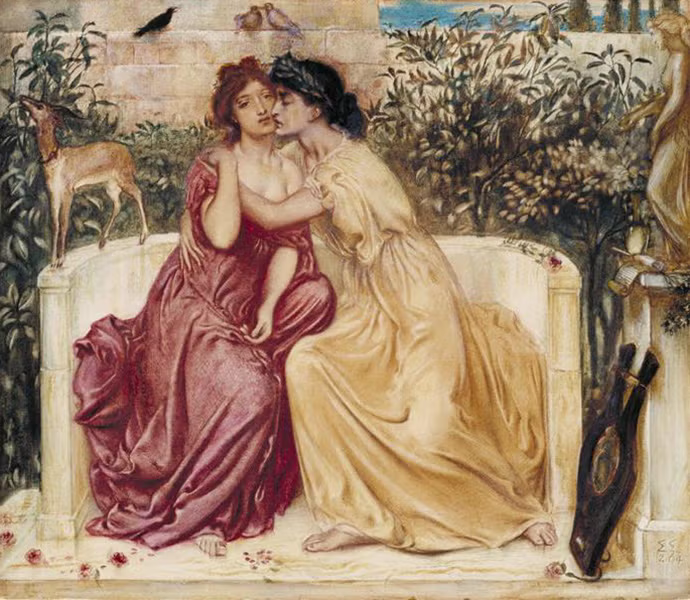
Art: Simeon Solomon, “Sappho and Erinna in a Garden at Mytilene”, (1864)
Greetings and blessings to you, Alice. Your story and suffering and willingness to share it touched my heart. I suspect often great suffering and great sorrow are openings to mystery.
I, too, feel a kinship and connection with Bridget. Here is a greeting. I wrote for her some years ago.
“ Welcome Bridget. Come ye in. Glad we are to greet our kin. Bridget of the blazing fire. Light our way. Feed our desire. Bridget of the flowing stream. Take us deep that we may dream. Light our path. Guide our way from winter’s night to spring bright day. Welcome Bridget. Come ye in. Glad we are to greet our kin.”
Bright and beautiful blessings to you and Alex.
That’s beautiful, San, thank you for sharing it.
And it was wonderful celebrating Imbolc with you. It’s always a joy to do magick together.