A homily for the Summer Solstice on June 20, 2025.
Dearly Beloved,
Blessed Summer Solstice, dear ones, and blessed Winter Solstice to all of you in the Southern Hemisphere. I greet you in the name of Aphrodite and the name of the Divine on this, the Summer Solstice of 2025.
I find myself sad and worried this solstice, dear ones. The state of the world and the state of my heart alike are tumultuous and wracked with pain. I am sad and worried for myself and all the other people who are feeling the weight of authoritarian boots on their neck. I am sad and worried for all of those in need who are suffering due to cruel and destructive cuts to spending on healthcare, food, and housing by the governments of the world, especially the government of the United States. And I am sad and worried for my student, an Iranian mage and mystic who is pursuing the Great Work via the initiatory system of the A.’.A.’. in a country where pursuing any spiritual path other than Islam is punishable by law and where Israeli bombs are now a constant threat.
But despite all of this global horror, I find myself consumed with a personal tragedy.
I have been estranged from my mother for about seventeen years. The details are unimportant. Just another childhood tragedy compounded by adulthood absence, all too common in this aching world.
I tried to get back into contact with her about three years ago and we exchanged a few messages, but nothing really came of it. There is just too much between us. Too much history. Too much pain. It would take a lot of work to get to a better place with her, to a place where we could even begin to really talk and spend time together again. So far, I’ve been willing to leave the ball in her court. After all, who wants to feel like they have to force interaction with their own mother?
But with things going the way they are in the US, I can’t help but feel like the time has come to push the issue. Both she and I are queer, and I’m afraid that if we don’t reconcile while we can, we may not get another chance. To be very clear, I’m afraid of one of us being killed or hauled away by agents of the US government before we have been able to reestablish a truly loving and connected relationship. And that thought breaks my heart.
So I’m writing her a letter where, in typical “Soror Alice Fashion”, I have chosen to lead with my vulnerability, bare my heart for her to laugh at and throw stones, and do my best to have faith that love will prevail nonetheless.
Needless to say, I’m terrified.
So on this blessed day, this longest day of the year, this day of light where the cycles of nature are warm and bright, I am called to speak upon the work we must do when things have gone wrong. The work we must do when things have frayed or even ripped apart. The work we must do when we have had a very bad day.
I am called to speak upon maintenance and repair.
Now, I know that I am repeating a theme here. I have spoken upon repair before. But I believe that it is a theme worth revisiting, and I will most likely revisit it again, because if there is one thing that modern “Western” culture is horrible at, it is doing the slow, unglamorous, and difficult work of building, maintaining, and repairing relationships. Our cultural myths, our movies, our novels, and our games are full of grand romantic gestures, of people burning all of their bridges and going “lone wolf”, and people just generally avoiding the often tedious work involved in living meaningful lives. Western—especially American—culture loves lone heroes and geniuses, tense moments and dramatic conflicts, and above all, we love the last minute, “all-at-once” solution, to the great detriment of almost every aspect of our culture except our TV shows, which have become a remarkably entertaining array of high art, shameless marketing, and pure, unadulterated trash.
But the “all-at-once” solution is not what nature teaches. Nature, at least on the scale we live on, is mostly full of slow, gradual processes of change and development shared across multiple systems. Osmosis. Radiation. Growth. Decay. Evolution. Reproduction. The lazy, drifting clouds that wend their ways across the skies. The gradual wax and wane of the Moon and the incremental rise and fall of the tides.
And there is great power in these gradual, incremental processes. Trees can work their roots slowly and carefully through solid stone and tiny drops of water can carve out immense cave systems. Gradually. Incrementally. Over time. Sure, these long, slow cycles are punctuated by intense and often catastrophic moments like earthquakes and forest fires, where a whole lot of change happens really quickly, but most of the time nature is in it for the long haul.
This basic reality is reflected in what has been revealed to humanity through mythology. In Hesiod’s “Theogony”, existence as we know it is birthed by the first generations of deities, often called the primordials, who, living in relationship with themselves and each other, literally give birth to our reality, step by incremental step. In the Babylonian “Enuma Elish”, Tiamat, the salty waters of the sea, and Apsu, the fresh waters that come up from springs, mingle over time to give birth to multiple generations of deities who, in the manner of deities, are both people, concepts, and things in the world. In the Hebrew Bible, the universe is not created all at once in an act of divine will from outside space and time. It is instead spoken into existence, step by step, over a period of days which poetically represent billions of years. Thus revealed theology mirrors what we see in naturalized theology…meaningful growth and development happens gradually, over time.
Similarly, our relationships are living things existing in nature. They are born, grow, develop over time, and, like all living things, relationships require energy and care to maintain or they can become ill or damaged. This means that if our relationships are damaged or become ill, then they take extra energy, care, and time to heal.
It can be easy to get frustrated with these natural processes and want to take shortcuts, but there are very few real shortcuts in nature. When it comes to living, growing, and changing things like relationships, things take as long as they take and they take as much energy as they take. In the end, you just have to take the time and do the work.
This means that our cultural addiction to epic tales and dramatic moments where problems are solved all at once with a murdered “villain”, a grand romantic gesture, or a throw-away joke is actually deeply unhealthy. This desire for quick and simple resolutions leads us to think about love and care for others in terms of single dramatic and defining moments, when real life reveals quite the opposite. Usually real love and care looks like the daily grind of cleaning up, getting groceries, doing chores, making sure meals are prepared, and sharing small, mundane, and deeply precious moments with those we care about.
I’ve celebrated ants and bees in both my poetry and my pastoral writing before, and I want to sing their praises here again: if you want to truly understand devotion and care, look to the love of our small and ubiquitous friends in nature.
Ants and bees, birds and beavers, trees and mycelia, all do their amazing work gradually and slowly, showing up every day and putting in the time and effort that it actually takes to build and maintain a world together.
We must do likewise.
So let us take the time and put in the energy necessary to take care of each other and ourselves. Let us show up, day after day, moment after moment, and do the work of maintaining our world and our relationships. Let us remember what we mean to each other, even when it’s inconvenient or boring or makes us sad.
Let us do the work of maintenance and repair.
Blessed Summer Solstice, dear ones.
In love,
Soror Alice
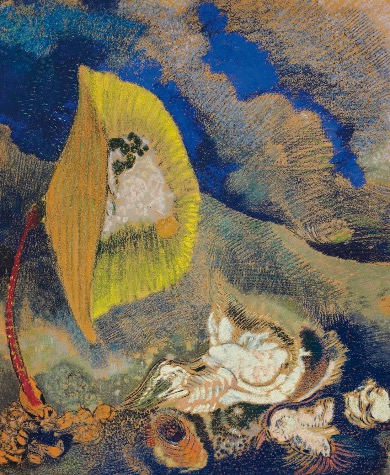
Art: Odilon Redon, “Vision sous-marine”, (1904)