A homily for the New Moon on December 30, 2024.
Dearly Beloved,
Blessed New Moon, my dear siblings! And such a perfect, Saturnine New Moon it is to end the year, with both the Sun and the Moon in Capricorn. We are at the end of one Moon cycle and the beginning of another, just as we are at the end of one year and the beginning of another, and unfortunately many of us are only looking forward to harder times. The world we are looking at as the new year begins seems to always be becoming harsher and more difficult. A shadow is falling over the newly reborn Sun and, as usual, the most vulnerable among us will be hit the hardest. I feel a weight upon my heart every time I look out upon our world.
Because of this weight upon my heart, I am moved to speak this month of a topic with which many among among us are very uncomfortable. I am moved to speak of the cutting edge of the blade, the setting of boundaries, and the ending of relationships.
I am moved to speak of severity.
As I mentioned, tonight the Sun and Moon are both in the sign of Capricorn. Capricorn is ruled by Saturn, the planet that is classically associated with limitation and restriction. Within Saturn and its associated deity Kronus, we see a myriad of overlapping and nested magickal and spiritual formulae, but they all come down to one thing: sometimes you have to cut. Kronus is usually depicted with a sickle, scythe, or harpē (a type of curved, sickle-like sword), and in His most well-known myth, Kronus deposes His father Ouranos—primordial god of the heavens—by castrating Him with his sickle, and through this act Kronus inaugurates the age of His rule as king of the gods…the Golden Age.
In his “Theogony”, Hesiod tells us that the father of Kronus, Ouranos, was evil. Literally evil.
“And he used to hide them (his three sons, the Hekatoncheires) all away in a secret place of Earth so soon as each was born, and would not suffer them to come up into the light: and Heaven (Ouranos) rejoiced in his evil doing.” -Hesiod, “Theogony”, (730-700 BCE), Translated by Evelyn-White, H. G. Loeb, parentheticals added by me for clarity
So Hesiod tells us that Ouranos rejoiced in locking His sons, each of which had a hundred arms and fifty heads, away in the Underworld. He hid them in the darkest, deepest place that exists and never let them out. Ever. He “would not suffer them to come up into the light”. He imprisoned His own children in the dark forever because they were born different. And He rejoiced in it.
Let that sink in for a moment.
Kronus was the youngest of the Titans, according to Hesiod, and He was the one who listened to the plan of Gaia (Earth), His mother. Gaia created the element of flint within Herself and shaped that flint into a sickle. She took that sickle and gave it to Her son Kronus and bade Him to punish His father. And so Kronus laid in wait, ambushed His father, and castrated Him, becoming king of the gods.
As is, this just seems like a typical tale of the young overtaking and replacing the old. If the myth stopped here there wouldn’t be much to learn on a spiritual level. It would just be a tale of a power struggle among the powerful…one such drama among millions. But this story surprises us. After the requisite bloodshed and changing of the guard among the deities, something truly miraculous happens.
From this act of rebellion, this act of punishment for the wrongs committed by Ouranos, a myriad of new divinities are brought into being: the Erinyes (Furies), the whole race of giants, the Meliae (tree nymphs), and my goddess and matron, the divine and blessed Aphrodite, who is described by Hesiod as being both “awful and lovely”.
And the reign of Kronus, arising out of this terrible violence against His king and kin, turns out to be the fabled Golden Age of the Earth, where humans did not labor, when there was no rich or poor, and all lived in comfort and plenty.
All of this from the blood of a divine tyrant mixed with the soil of the Earth, blessed Gaia. All of these new divinities, new powers in the world, were born from a single act of rebellion by a son who saw the wrongs committed by His father and then said “No more.”
And so Kronus became known among humans as the god of endings, of limitations, of discipline, and of severity. But because His severity led to a Golden Age Kronus was also a patron of the harvest, as the name of the Ancient Greek harvest festival “Kronia” attests.
So what can we learn from this myth? What meaning can we find in this story of fathers, sons, and the rage of a mother whose children were being abused? The formula of Saturn is hidden in this story, ready to be discovered by the wise. What is it?
The sickle is the key. We must ask ourselves this: “Why a sickle, specifically? Why not a sword or knife, far more common weapons?”
The answer is that the sickle ends up being both the weapon of rebellion against an abusive ruler and the tool of a farmer bringing in the harvest. Sickles have been used in many peasant revolts by the same farmers that had been using them to harvest grain a week before. The sickle is simultaneously that which cuts off, that which brings things the life of the plant to an end, and that which brings growth and bounty to the world by turning that death into new life. The sickle is a symbol of the principle of severity, of discipline, of the need to make the hard choice and do something painful in order to bring about a better future, but it is also a symbol of new beginnings and new life.
Sometimes in our lives we will need the sickle of Kronus. The 20 year heavy drinker who must painfully throw away the bottle to save his own life, his marriage, and his relationship with his children. The frightened wife who must end her marriage before the violence turns upon the children. The trans woman who, after living a hollow, painful life for decades, must let her old, false self die as her new, true self is born. All of these are examples of the sickle of Cronus. All of these are examples of what can be gained through the right kind of severity in the right place.
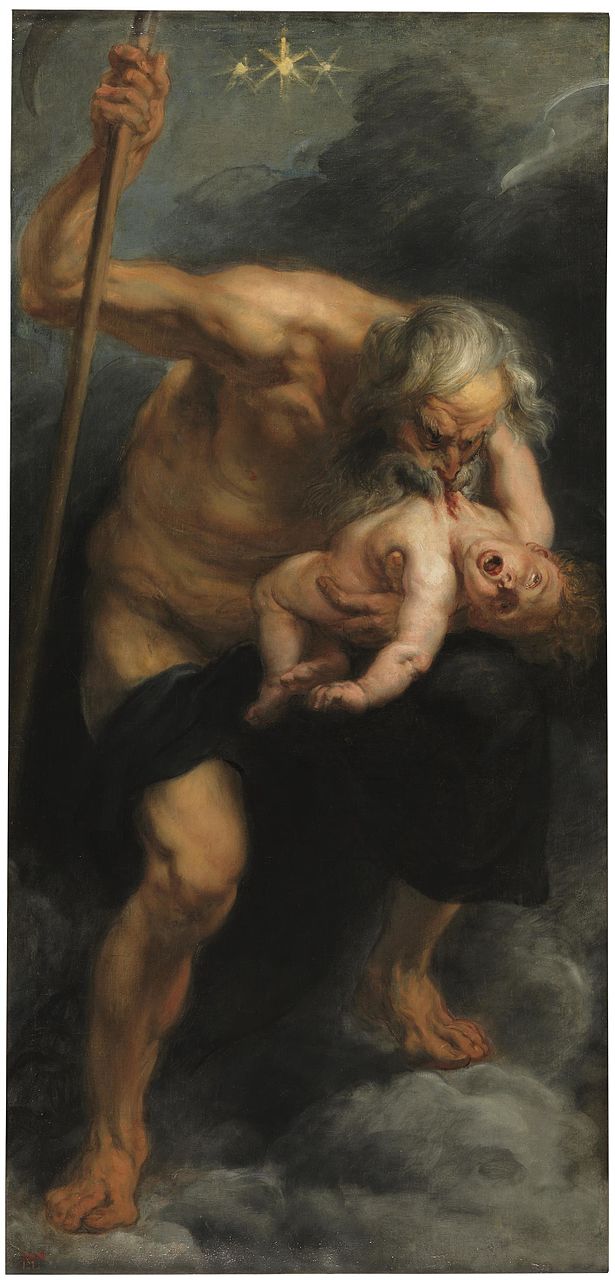
But there is a thorn on the rose, a worm in the apple…of we wield it improperly, it is all too easy for the sickle to turn onto us. Kronus came to love violence and power too much for the Golden Age to continue. He ate His children, out of fear they would depose Him as He deposed His father, and finally Rhea—again a goddess who had to act to end the abuse and tyranny of Her partner—gave birth to Zeus in secret and sent Him off to be raised by others. The details differ based on the teller of the myth, but the results are always the same: Zeus comes to maturity and deposes Kronus and the other Titans. The Olympians come to power and Mount Olympus becomes their base of operations. But there is a price.
There is always a price.
When Kronus deposed Ouranos, He brought about a Golden Age…but He didn’t end the atrocities of His royal father. He didn’t free His powerful siblings, the hundred-armed Hecatoncheires. He didn’t free the giants (literally an entire race of people). He kept the wild and raw forces of nature locked in Tartarus and went about His business. This was the sickle again, the severity of Kronus saying “No”, as is His formula. But that choice comes to haunt Him as His own son comes to make war upon Him with His monstrous aunts and uncles at His side. The wild forces of nature are joined to the power and wisdom of Zeus and the combination defeats the forces of limitation and severity. Suddenly progress is possible, but it is still through the formula of Saturn, for it is through the ending of the god of endings. The sickle has again given birth to new life through the power of death, and as Kronus is imprisoned in Tartarus with His own prisoners, the irony lays thick on Mt. Olympus like smoke.
But the price is the end of the Golden Age. Humanity comes to live as it does now, toiling for food and shelter and making war upon each other for territory and power. The Olympians have to hold the hostile Titans and giants—the old deities and the raw forces of nature—at bay, as Gaia gives birth to monsters like Typhon to take revenge for the fate of the Titans. The cycle of severity, of people being forced to make the hard choices and live with the hard consequences, continues. Saturn always returns, every 30 years or so, for all of us. The sickle always comes to end the past cycle and simultaneously give birth to the new. This is the cycle of existence. This is the way things work.
So I ask this, dear siblings, where in your life do you need to wield the sickle? What way of being, what belief or habit or practice, has come to its natural end? What relationship or occupation has become abusive or toxic? What cycle has come to its end? What tyrant needs to deposed by the power of Saturn?
It is said by some that Dionysus will succeed Zeus as Zeus succeeded Kronus and Kronus succeeded Ouranos. That the mysteries of the the death and rebirth of Dionysus, His divine intoxication, His revels and wanderings in many lands, are a new formula that will define the world for a time as the rule of the Olympians has defined our age. Perhaps this is true. Perhaps when He comes with His divine madness, we will no longer need the sickle of Saturn.
But this time is not yet. In our world we need the sickle of Saturn, we need severity, we need to be ready to make hard choices and stick to them. Again and again in my writings, I repeat that I believe in a naturalized theology. I believe that nature is our surest indicator of the nature and will of the Divine and this gospel, the gospel of nature, is what I teach and preach to anyone who will listen. So it is fair to ask me where we see the sickle of Saturn, this cycle of severity, of endings and death leading to new life, in nature. My reply is simply this:
Ask the dinosaurs. They died and it made room for us, for our world. Our civilization is literally built on the energy we get out of burning the remains of the corpses of ancient dinosaurs, plants, and even some early mammals. Ask the trees that we cut down to build and heat our homes, the plants that we cultivate and then kill to feed our children, and the animals that end up on our plates. Everywhere we look, we see the sickle of Saturn at work. Our world is built upon it. Life feeds on death as death feeds on life, in a neverending spiral emanating from, and eventually returning to, the Divine.
So look to your lives, in this most Saturnian moment. Look to the world around you. Where are the tyrants that need to be deposed? Where are the ages that need to come to an end? Where do you need the power of the sickle?
Where do you need the power of severity?
Blessed New Moon, dear siblings.
In love,
Soror Alice
Art: Paul Rubens, “Saturn”, (1636)