A homily for the Summer and Winter Solstices and the Full Moon in Sagittarius on 6-20-24.
Dearly Beloved,
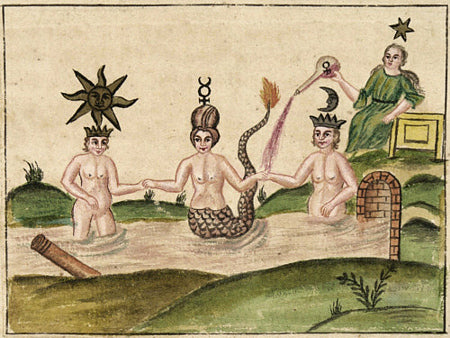
What a special configuration of astrological elements we have today! It is the solstice, both Summer in the Northern Hemisphere and Winter in the Southern Hemisphere, and it is also the Full Moon. Given this rare conjunction of events, I am moved to speak today of the spiritual marriage between the Sun and the Moon at the heart of so many magickal traditions. I am moved to speak of the Great Work.
I have been a mage for most of my life. My parents were witches, and my mother taught me my first spell (a healing spell for my already chronic headaches), took me to my first ritual (I was five…all I really remember was that the host had a secret room in his house and I thought it was very cool), and bought me my first book on magick for my twelfth birthday (“Modern Magick” by Donald Michael Kraig). It was in that book that I first ran across the idea of the Great Work and I can say that, more than any other single idea, it is the Great Work that has driven and governed my life. I am a 100% unashamed and unabashed True Believer in the Great Work, and I have made most of the major decisions of my adult life with the Great Work in mind.
But what is the Great Work?
Put simply, the Great Work is the unification of all spiritual opposites within the mage or mystic, with the ultimate goal of the unification of the individual mage with the Divine (however that Divine is conceived).
This unification with the Divine is conceptualized differently in different magickal and spiritual traditions based on their varying cosmologies and metaphysical systems, but it always comes down to this: it is the true solution to the problem of being a person. It is the secret of life, the Summum Bonum (“the highest good”), the Philosopher’s Stone, theosis, the reunification of subject and object in the Real, samādhi, kenshō, and dozens of other words and phrases that all boil down to one thing: it will repair that which is broken. It will remedy the problem of existence, at least for us as individuals. It will unite the Lover with the Beloved and, to paraphrase the words of St. Paul, we will “know fully” even as we are are “fully known”. This was what the alchemists of old sought.
Oh, for sure, some of our forebears were avaricious or ambitious. Some sought gold—actual metallic gold, not any metaphor for spiritual attainment—and whether because of a quirk of personality, actual greed, or out of dire need, it is not my place to judge them. As “Liber Librae” would counsel me, how do I know that in their place I could have resisted the temptation, and even if I could, why should I despise one who is weaker than myself?
But setting aside these few people who out of greed or need sought the Philosopher’s Stone because of the legends of miraculous wealth, the other alchemists and mages of the past, our beloved ancestors, mighty dead, and blessed saints, sought something greater. They sought the Divine, in a myriad of differing forms, names, mysteries, and sacraments, and their method was the same: the unification of opposites.
In “Western” magickal systems, we would speak first in terms of the elements. Water must join with Fire, Earth must join with Air, and each must join together, all in their proper relations, and all unified by Spirit. This is, of course, only one way of speaking of all of existence by breaking it up in certain parts and then talking about how those parts relate, and it only applies to our level of reality, the microcosm, symbolized by the pentagram. But we, as the clever children we are, have come up with other ways of talking about existence. There is also the macrocosm, symbolized by the hexagram, and on the macrocosmic level of reality, we may choose to speak in terms of planets and constellations.
Astrology is one of the oldest documented forms of magick, and it goes deep into the core of many of the various magickal systems that we have inherited in the 21st century. Astrology has a lot of complexity to it, and there are controversies within the field that I do not wish to address in this place. Instead I wish to talk about the importance of the Sun and Moon in their relation to us here on Earth.
As pagans, we believe in a naturalized theology. We look to nature for our knowledge of the supernatural and the physical for our knowledge of the metaphysical. And what within the natural world is more important to us than the Sun and the Moon? The light of the Sun provides the energy all life on Earth requires to exist, while in the pull of the tides and the rhythms of the changing Moon, all life on Earth waxes and wanes together. These two lamps light our way through our world, and their changes, during each day, week, month, and year, see us through our lives. These two beautiful, lumpy spheres are our parents, and they unite in their influences—both physical and magickal—to give rise to our world.
It is this marriage of opposites, of the light of the day and the light of the night, of the Sun and the Moon, that gives birth to the unity that is our lives. And thus it is in this marriage of Sun and Moon that the ancient alchemists symbolized the Great Work.
So as these two cycles intersect, as the Full Moon and the solstice comes together, consider the Great Work. Consider your own path, your own spiritual life, and where it is leading you. And most of all celebrate the life that these two glorious lights in our sky give us. Celebrate the beautiful world and the amazing people upon which they shed their light.
Happy Solstice and Full Moon.
In love,
Soror Alice
Art: “Figures representing the Sun, Moon, and stars consort with a being that is half human female and half reptile.”, From the alchemical manuscript “Clavis Artis”, (1738)