
A sermon for Good Friday on April 18, 2025.
Dearly Beloved,
Blessings upon you, dear siblings. I greet you in the name of Aphrodite and the Divine.
I was not going to write a post for today. That’s why I’m posting so late. While I straddle the three traditions of witchcraft, Thelema, and Christian mysticism in my own Work and spiritual life, I am a priestess of Aphrodite and the spiritual community that I serve is primarily pagan. I do not serve the Christian sacraments and do not receive them, and while I engage in personal exegesis of the Tanakh and New Testament for myself, normally I would not engage in public exegesis of those texts in the same way that I would with Liber AL or the Hermetica.
However, I had an experience today that was so singular, so strange, that I had to take it as inspiration from the Divine. I saw a doomsayer. That’s right, you read that right, an actual doomsayer. He had a megaphone and a big sandwich-board he was wearing with John 3:16 written on it in big, red, angry letters. He was holding a sign, and it was this sign that made me feel the calling to write this piece today. His sign read, in the same big, red, angry letters, “God Is Angry With The Wicked Every Day” and cited Psalms 7:11.
This man was pacing angrily back and forth on the street corner, screaming into his megaphone so intensely I could see the spit flying. His face was red and distorted, his voice cracked and tragic. He looked tired.
He looked miserable.
This man was weighed down by a burden no one could ever live up to: perfection. He saw the same thing in himself that he saw in the world, a mass of confusion where people so often fall short of the goodness, truth, and beauty of which we are all capable. He saw viciousness and pain and people who are greedily harming others for their own benefit, and he had the reaction that most of us have: moral outrage. And most likely, when he tried to confront people about their ethical failures, the response was not what he expected. He expected people to be horrified at the harm they had caused, to experience remorse and compunction like he does, and when they didn’t, he experienced even more moral outrage, until finally it crossed over from outrage into anger and from anger into rage, until finally he was pacing angrily on the street corner, screaming about the rage of the Divine.
I can relate.
An anecdote: one of my earliest memories is of being bullied by a group of neighborhood boys. Once they realized I was an easy target—at that age—they all crowded around me in a big circle and started yelling insults and hitting and kicking me. I fell to my knees in the center of the circle and endured their attacks with my head down, until finally I screamed out, in rage and pain, the most horrible thing I could think of: “I hate you!”.
In my naïveté, the young heart that was being raised on equal parts She-Ra cartoons, witchcraft, the Bible, and the tail end of the Cold War thought that the worst thing that anyone could feel was hatred. When I learned about the Holocaust, about the gulags, about slavery, about Jim Crow, it was always couched in terms of horrible wrongs being caused by hatred. I had read a scripture that literally said that God is love, and my dictionary said that hatred is the opposite of love. My little autistic brain had just done the math and come to a result.
So when I felt so hurt, so humiliated, so driven to my limits, it was the only thing I could think of to say. “I hate you”. It hurts just to write it. It’s against everything I stand for, everything to which I have sworn myself. And yet I said it to them. In my rage and pain, I missed the mark.
And they laughed.
I had committed the most horrible sin my six year old mind could conceive, and they just laughed at me. I had hated, and it wounded me horribly.
They beat me down that day. I was covered with wounds and bruises for a couple of weeks as I healed physically. But I have never truly healed from that moment. That was my “original sin”. That was the moment where I did wrong not out of a childish impulse or simply not understanding the rules, but out of rage and pain.
The same rage and pain that I saw on that young man’s face as he screamed into that megaphone.
When we see others do wrong, especially when we are hurt by it, it’s common to feel moral outrage and anger. The psalmist in Psalm 7:11 (traditionally believed to be King David) recognized this. When read completely, the psalm reveals a singer who was persecuted by enemies, just as I was on that street corner in Texas, oh so many years ago. The psalmist is hurt and angry and calling out for justice in what feels like an unjust world, and he is trying to assert that the Divine will punish these “wicked” people that he sees around him every day. This is not an assertion of the nature of the Divine. It is not a theological exposition on the attributes of the Divine. It is a song written by a deeply faithful man wrestling with pain and anger and a lack of understanding.
This is why good exegetical practices are so important. Using “clobber-texts” or proof texts in this way removes all context about what is being said. The Book Of Psalms is incredibly beautiful and an inspired text, but it is also the spiritual songs of a particular set of people living a particular set of experiences during a particular time.
Part of the glory of holy texts and myths is that they are able to speak to each of us in whatever moment we are living, thus we can learn and grow from reading and contemplating these texts, praying the psalms, and even writing our own psalms. But we cannot take sections from these texts to excuse our own moral failures. And I want to make clear, this young man screaming about the rage of the Divine was failing morally. He is blameworthy. He was committing a wrong. He was filled with anger at the injustices of the world around him and projected that feeling onto the Divine, thus deeply, deeply misrepresenting the Divine as wrathful and vindictive. He cherry-picked a single sentence from a book that is filled with glorious messages of the grace of the Divine, the love of the Divine, the forgiveness of the Divine, and used that sentence to make a monster out of the Divine.
This bothers me.
A long time ago, on a day very much like today, the Divine incarnated as a person, lived a life, had a family and friends, tried to do His will, and was tortured and executed by the colonizing forces of the Roman State for his efforts. It wasn’t the first time the incarnate Divine had been killed by a human, though according to the canon tale Krishna’s death was a hunting accident. There may be others that we don’t have records of, of course. But what distinguishes the tale of Christ is that He is wrongly executed, that He is persecuted both by His own people and the Roman state. His torture and death is ethically wrong as well as unfortunate.
And yet…forgiveness.
And yet…love.
Yes, bad actors, empires and churches and pastors who cloaked their crimes in the Cross, have and are committed great wrongs in the name of Christ and in the name of the Divine. But the actual messages of the Divine, both inside and outside Christianity, reveal to us a Divine that manifests in the best of everything we can imagine. The Good, the True, and the Beautiful…these are the fundamental attributes of the Divine we can reason our way to from our basic spiritual intuitions. Scriptures from the civilizations of the world fill in some of the gaps from there. Reason helps us a bit. Gnosis helps us more. But when an avatar like Krishna or Christ comes into our world, when we experience a “divine invasion” as Philip K. Dick put it, we can experience the Divine as a person. When we experience the Divine as a person, we see that that person has specific traits. Krishna would not lift a weapon, even as He served as Arjuna’s charioteer. Christ preached forgiveness, even as an oppressed minority in an occupied land. Both talked about the Divine as love. Both preached forgiveness. Both preached peace.
So six-year old me wasn’t exactly wrong. By hating, I was missing the mark. I was transgressing against the Divine by acting against love. Hate is, in fact, wrong. But the devastating guilt that I felt about it was just me torturing myself. In believing that the Divine could not forgive my childish transgression, I was believing in the wrath of the Divine over the love of the Divine. I made the pain I felt because of my initial wrong far worse by doubting the love of the Divine, by doubting Their forgiveness and grace. But when the Divine has revealed Themselves as a person, that person has always been loving, peaceful, and forgiving. To the degree that the Divine has been revealed through the theosis of the blessed saints, the Divine has always been revealed in those people as loving, peaceful, and forgiving. In the vast majority of the holy texts that have been revealed to the world, the Divine has been revealed, in all Their myriad faces, as peaceful, loving, and forgiving, and it has been shown that even when wrath is necessary, that that wrath is like the fire that kills off the brush and dead wood so that the forest can thrive. Nature reveals the same truth…when winter comes it feels harsh and cold, but that time allows the old life that has died to be composted into the soil for new life to grow.
Malice is human, vengeance is human, wrath is human…these are human vices, ethical errors that we are prone to fall into because of what sort of being we are. But when we are at our best, when we look to the virtues, we aspire towards the Good, the Good that we experience as an attribute of the Divine. And the Good is loving. The Good is kind. The Good is willing to do the necessary work to bring the Good into the world, even when that work hurts.
Most of all, the Divine is love. St. John The Evangelist said it and I believe it from the bottom of my heart. That’s why I serve Aphrodite as priestess. That’s why I’m both a Christian (of sorts) and a Thelemite (of sorts). I believe in love, devoutly and absolutely.
As usual, I’m putting my heart right out there on my sleeve and trying to lead with my vulnerability, so I will acknowledge that I have written all of this because an angry young man with a sign and a megaphone preached a monstrous, vindictive, and deeply impious view of the Divine to an audience of zero and it provoked me. It’s actual, and I do not use this word lightly, heresy, as well as blasphemy. And it made me deeply upset.
So on this day when an incarnation of the Divine was executed unjustly by a wrathful state desperate to maintain colonial control, a day when a wrathful young man screamed himself hoarse preaching a vision of a wrathful god, I must assert, with many others and of one voice and mind with both tradition and scripture, that the Divine is love.
Thus I serve love.
Blessed Good Friday to all who celebrate. I will wait, as I do every year, for the promise to be fulfilled yet again on Sunday. Until then…
In love,
Soror Alice
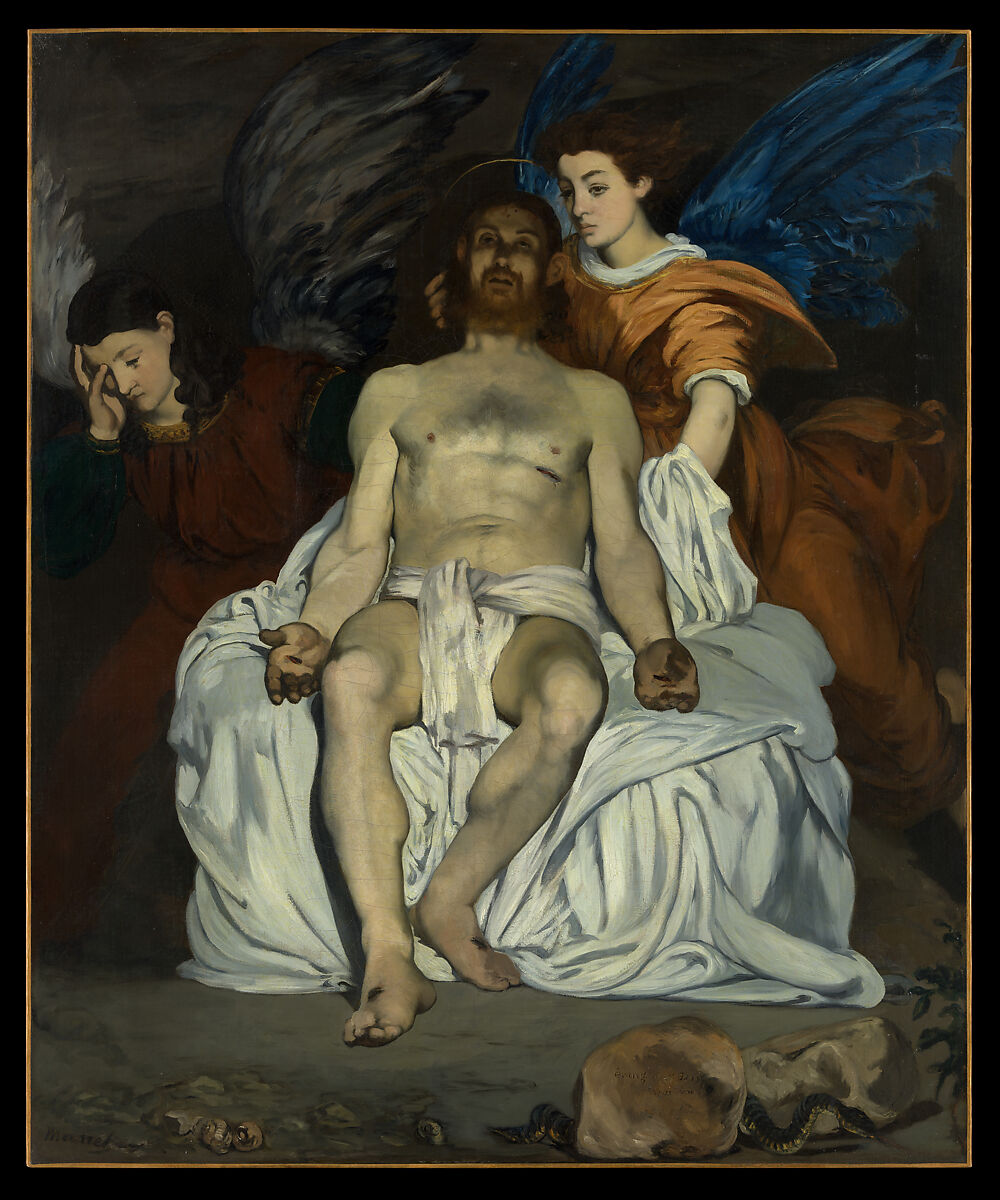
Art: Edouard Manet, “The Dead Christ With Angels”, (1864)
This is so deep and personal and true. Thank you.
I’m glad it resonated with you! Thank you for reading!