In which I ground the assumptions behind the Xeno Position.
Now I want to consider not what time actually is or how it affects objects (these are questions for the physical sciences) or how the metaphysics of time make possible our interactions with temporality (this issue was addressed in the previous chapter); instead I wish to address an entirely different question: how do we experience time and how does that experience give rise to our available possibilities?
So far, my metaphysics has included three elements: objects, properties, and relations. Now I want to introduce a new element: subjects. Where the object is experienced, the subject experiences. Where an object is defined in my system as a nexus of relations that give rise to its apparent properties, I define a subject as a nexus of “relationships”, relations which are subjectively experienced and give rise to the internal experience of self. Thus a subject does not merely lay in relations like an object, the subject is engaged in relationships. These relationships are always pointed…while we may hold complex attitudes, thoughts, and emotions about something in our world or ourselves, those attitudes, thoughts, and emotions always have a “directionality”, a “valence”, an “intentionality”. Our relationships with the world, objects, and other subjects in the world are always “about something”, always “interested”, always “subjective” (in the sense that they involve the subject). There is no such thing as a disinterested, “objective” engagement or relationship with reality, because “engagement” and “relationship” are always interested, always subjective, and always situated by their very nature.
Please note that these definitions do not exclude the metaphysical possibility that what we perceive as objects (nexuses of relations) may actually be subjects (nexuses of relationships). Indeed, I tend to subscribe to a sort of panpsychism or animism where most, if not all, apparent objects are actually also subjects. But for the purposes of our current discussion, I want to talk not about what those things which we perceive as objects may actually be “in themselves”, but instead about how we, as the sorts of subjects we are, engage with those objects and other subjects in the world. I am not interested in Kant’s “ding an sich” (thing in itself) right now; instead I am interested in how subjects engage in relationships with each other and with objects in time.
However, in order to do any sort of justice to this topic, I must first explore some details of the Xeno Position so that I may firmly ground our investigations.
The astute reader may have recognized that what I call the “Xeno Position” is a variation on the “phenomenological reduction” made famous in the works of Edmund Husserl, et al. In the Xeno Position, I ask the philosopher of magick to suspend all judgments and previous knowledge as much as possible and focus instead on the basic position in which we find ourselves in every moment of our existence as the sort of entity we are and which is experiencing the sort of world which we are experiencing.
The form of this “bracketing” position is simple: you are the “alien”, thrust into a world you do not understand and of which you have no memories. You possess no memories of yourself, why you are in this world, or what sort of entity you are. No one around you seems to be able to give a satisfying or even adequate scientific or philosophical accounting of you or your current situation. All you have are your current experiences of the world, a basic knowledge of the local language, and your reason.
Given this position, what should you, the alien, do? I argue that once in this position, it makes the most sense to attempt to:
Discover as much as possible about the rules and properties of the world.
Discover as much as possible about the rules and properties of yourself.
Discover why you are here.
Once you discover why you are here, pursue that purpose/mission to the best of your ability.
The astute reader will also note that there are some assumptions that creep their way into the Xeno Position:
Ontological Assumption: I assume both world and mind as phenomena.
Lawfulness Assumption: I assume that both the world and the mind follow rules or laws.
Facticity Assumption: I assume that there are facts about the world and the mind.
Epistemological Assumption: I assume that it is possible to produce knowledge (justified true beliefs) about both the world and the mind.
Teleological Assumption: I assume that the mind has teleology, which is to say that I assume that the self (the body-mind complex) is here for a reason, to fulfill some sort of function or to achieve some sort of goal-state.
These are some pretty big assumptions.
In previous chapters I was able to sidestep this problem by focusing on basic principles, but now we are dealing with the meat of the issue…the phenomenology of time cuts right to the root of what it means to exist as a self and thus it cuts right to the heart of the Xeno Position. We literally can’t imagine what it would be like to exist outside time, because imagining is an action that takes place in time. Any such flights of imagination would have a beginning, a middle, and an end, all of which can only occur in an already existing temporal realm. It is true that in some mystical states we experience a subjective state of timelessness, but that experience itself always began at some time, took place over some duration, and ended at some time…it is subjectively timeless, but it is also still bounded in time. Time and embodied consciousness are inexorably bound up together.
This issue is not avoided by the relational A-B model of time that I developed in the previous chapter. Just because we recognize that relations are primary in our metaphysics and our notion of the temporal realm doesn’t mean that there is not a temporal realm…we clearly live in time. It also does not mean there is not an eternal realm…as an idealist, I contend that at least some ideas bear ontological freight and that those ideas occupy a level of existence appropriate to them and which is necessarily timeless. The number two is always the number two and necessarily cannot change; we may learn new facts about the number two as we develop our number theory, but as an idealist I believe that these facts are not being invented by us, they are being discovered by us.
Note that some form of idealism is assumed in most extant theories of magick; the entire notion of the “Law Of Correspondence” (things which resemble each other symbolically are magickally connected) only makes sense if there is e.g. a concept of “fiveness” with which the pentagram, the pentagon, the various crosses (remember that all crosses have the center point, which in many systems symbolizes elemental Spirit), and the actually existing five elements all equally correspond and which makes it possible for us to call upon elemental forces through the proper manipulation of those symbols.
But my arguments for a relation-centric metaphysics and for idealism don’t justify the assumptions I have made in creating the Xeno Position. So I can’t avoid these issues anymore…I have to explain why I believe these are worthwhile assumptions upon which to build the Xeno Position and from that position the entire systematic philosophy of magick which it is my mission to create.
First we must tackle the Ontological Assumption (things I assume to exist), because if nothing exists, then there is nothing to talk about and no one to do the talking.
The self—defined here as the subject, a mind possessing self-awareness, beliefs, and desires—exists: I believe that the self/mind exists because I have the ability to consider the question of my own existence and, so far as I know, only minds can consider questions at all. Computers can ask questions due to their programming, of course, and it could be that my mind is simply a sophisticated computer, but this is a question of definition, not existence. Whatever minds may turn out to be, I think it is safe to say that they exist. Please note both that this is a riff on René Descartes’ “cogito” argument and that while I have technically only proven the existence of my own mind, I am excluding the possibility of solipsism because it is just silly; I see no need to refute a position no one could simultaneously hold while acknowledging that I exist to argue against it.
If anything at all exists (including minds), then the world exists, since the world is defined as the totality of that which exists. Note that I am not excluding the possibility that existence is primarily or entirely mental, as argued in some magickal and mystical theories. I am open to a complete idealism, I just think that it is unlikely because our experience of the world, the phenomenology of the world, seems to imply some sort of dualism between ideal and physical where one connects to the other via the phenomenon of mind/subjectivity. However, I do not want to argue for any form of dualism. Instead, I want to argue for a form of dual-aspect monism, where the temporal and the eternal, the actual and the ideal, are two ways of experiencing the same phenomenon. But I haven’t gotten there yet. Stay tuned!
Next is the Lawfulness Assumption.
Once assured of the existence of both the world and myself, I am free to start making observations, and one of the first observations I make is that there appear to be regularities in my experiences of both world and self.
Certain events always precede certain other events, and when I act upon the world and self in certain ways, certain events reliably follow (barring interference).
The fact that some of these patterns in my experience seem to always hold in all similar situations implies the existence of laws/rules in both the world and the self. Note: this world may still prove to be a simulacrum or false projection of some sort and mind/self may ultimately be an illusion of some sort…my only claim is that our experiences of both the world and mind both present regularities that are so inductively consistent that they can be considered rules until contradicted by experience.
Now for the Facticity Assumption.
Let us assume, for the sake of argument, that the Facticity Assumption is false and that there are no facts about the world or the self/mind.
Proposition 1 would be a true proposition about the world and mind, thus it would be a fact about the world and mind.
Therefore there exists at least one fact about the world and mind, disproving proposition 1 and supporting the Facticity Assumption.
Now for the Epistemological Assumption.
Given world, mind, rules that govern the two and how they interrelate, and facts about both, it seems to follow that I can use the interrelations between mind and world to make comparisons and draw connections involving the regularities in my experiences of both world and mind and that this process will allow me to ascertain facts. For example, I can observe that my mood changes over time despite the fact that my physical circumstances are the same and draw the conclusion “states of mind are sometimes independent of states of body”.
Making these comparisons systematically using consistent and alethic (truth-bearing) rules of inference (please refer to the chapter of this work on logic), I can draw correspondences between 1) propositions and other propositions and 2) propositions and states of affairs in the world.
Once I can draw correspondences and make comparisons between propositions and other propositions in my mind and propositions in my mind and states of affairs in the world, I can use alethic inference rules and experimentation to form justified true beliefs (aka knowledge) about both.
Now for the monster in the study: the Teleological Assumption. So far, my claims haven’t been too hard to swallow…all I have basically claimed is that the world exists, that we have minds and that those minds exist, that there are rules that govern the world, the minds in it, and how they interrelate, that there are facts about both the world and minds, and that we can know about all of this. I hope that, if nothing else, we can agree on these basic ideas. And I have argued for all of these things phenomenologically, because I have based all of these arguments on our basic experience of existence as the sort of entity we are, having the sort of experience of existence which we are having. But how can I argue that the self/mind has a telos, a purpose, or that at least some subjects have a defined goal state?
First, for the sake of excluding it, there is a sort of argument that I will call the “Pessimistic Teleological Argument From Physics”.
The brute fact of the directionality of time and the brute fact of entropy seem to be two aspects of the same phenomenon, a phenomenon which seems to give rise to time as we experience it.
Our observations of entropy and time and how they affect the world essentially present the universe as a clock that is slowly winding down as all usable energy (including the energy holding matter together) is eventually lost to heat. That heat then disperses following the laws of thermodynamics until its energy, its ability to cause changes, is lost forever. This is commonly called the “heat death of the universe”. The directionality of time seems to ensure this.
This means that according to this model of physics, the universe and everything in it—including the alien—actually has a goal state, a state that everything in the universe is working its way towards…the state of nothingness.
I want to reject this argument for several reasons that are purely scientific. Several physicists have pointed out that this argument is unsatisfying. It is countered with the following:
The meaning of the word “entropy” for the universe as a whole is undefined (Planck, 1897, 1927).
The universe has not been proven (nor can it be assumed) to be a closed/isolated thermodynamic system (Buchdahl, 1966, 2009).
Even if the universe is a closed/isolated thermodynamic system, it has not been proven (nor can it be assumed) to be in equilibrium, which means we can’t associate an entropy value with it (Tisza, 1966).
However, there may be something to this notion of the telos of the alien being nothingness. Several mystical traditions posit that the ultimate reality is, very simply, nothing. From the sūnyatā of the Buddhists and the Ain of the Qabalists to the quantum vacuum of the physicists, there is strong testimony and argument for the idea that reality is ultimately “empty” or “nothingness”.
Despite this possibility, it isn’t possible for us to definitely know that the telos of the alien themselves is actually “nothingness” or “emptiness”. While the Buddhist traditions do make this claim, the Qabalistic tradition is that the Ain, Ain Soph, and Ain Soph Aur contracted by Their very nature to a point and that this point gave rise to the sephira Keter, which in turn gave rise to the rest of existence. The Greek creation myths similarly claim that originally there was “chaos”, from which arose the first primordial deities such as Nyx, both of which imply the physical universe is a sort of growth out of nothingness or some sort of amorphous “chaotic” substance with no properties (which makes it effectively nothingness). Nothingness in this sense, rather than being portrayed as “absence”, is instead conceived of as full of possibility and potentiality and acts as the ontological ground of our phenomenal existence. Given this positive “growth” model, the telos of the self/mind may very well be positive and active for all or most of its existence, only falling back into the divine nothingness at some ultimate point of nibbana or apotheosis.
As a thoroughgoing pagan who believes in a naturalized theology (and thealogy), I find appeal in the notion of both physical reality and the self/mind as growing things that have a life cycle where they arise from nothingness like a seed opening and putting forth its sprout and then return to nothingness like the dead plant falling back to the Earth. Under this model, the telos of the self is then to grow and develop according to the internal telos defined by the nature of the individual as a function of their relation to their environment, and then finally to fall back into nothingness.
Nonetheless, while I find this model compelling personally, I cannot argue for it deductively or inductively. There is, however, an abductive argument (“argument to best explanation”, please see the section of this work on logic) that can be made here. We can observe that the alien is a living thing, a body/mind complex, and that while we do observe minds without physical bodies (deities, spirits, etc) and physical objects without minds (or do we?…perhaps there is an argument to be made for animism/panpsychism), the alien is neither of these…they are an embodied mind, a living person. If we abandon the human exceptionalism so prevalent in most “western” spiritual systems, then the alien and all other humans are living things just like any other flora or fauna on this planet. When we observe other living things, e.g. trees, we see them fulfilling a sort of telos that is defined by their internal characteristics. The tree grows, responds, and acts from their internally defined “nature” in relation to their environment and the other living things around them. A materialist might cash out these internal characteristics in terms of DNA, but most magickal systems would also include an energetic/spiritual basis for any given tree. In any case, the telos of the tree is clearly a function of their identity in relation to other living beings and their environment.
What I take from this abductive argument is that the telos of the human—and thus the alien—would be defined in terms of the relations between the individual characteristics of the alien, other living beings, and their environment. This means that by properly understanding the individual, their relations, and their relationships to the world around them, one could theoretically deduce the telos of that individual. Notably, most magickal and mystical systems include some variation of the Delphic maxim “γνῶθι σαυτόν” (know yourself), with various practices such as the Thelemic practice of “Thisharb” devised explicitly to explore and discover the self, and most magickal and mystical systems include similar practices for coming to understand other minds and the environment. Indeed, coming to understand oneself and to develop a magickal theory of the world and other minds is a large part of many magickal systems.
Note that this is not an argument from analogy. Humans are not merely analogous to other living beings in the world. We are living beings in the world. I am explicitly denying that humans enjoy some sort of special spiritual or magickal status. We are not any more the “microcosm” of the universe than any other living being. My argument is that we are organisms like any other that we know of, and that when we ask ourselves about the telos of any other organism we know of, we do not think in terms of some special destiny where e.g. the oak tree down the street is destined to become the new tree magus of the new tree aeon or the next tree Picasso. Instead we think in terms of the tree’s natural growth and development in relation to their environment. I am arguing that we need to think about the telos of humans in the same way.
Yes, our social, political, and personal spheres are a part of our natural growth and development, but these are not different in principle from any of the spheres in which the tree lives and interacts with other organisms and their environment. We are not special, thus we do not need some special explanation of our telos in terms out of some movie or novel. We merely need to understand ourselves as one living being among many, and then our telos, our “pure” or “true” will as Thelemites would say, becomes discoverable through an examination of ourselves and our relationships with other subjects and our environment. This, then, is my justification for believing that the alien has a telos: because every other living thing we observe has a telos, which is to grow, develop, and interact in relationship with their environment and other living beings, and finally to fall back into the nothingness from which they came, and the alien is a living being.
I hope that this explains and justifies the assumptions I have made when developing the Xeno Position. With these concepts properly developed, I will turn my attention properly towards the phenomenology of time in the next chapter.
Works Cited:
Max Planck, Treatise On Thermodynamics (Translated by Alexander Ogg), (Longmans, Green and Company Ltd, 1927)
H. A. Buchdahl, The Concepts Of Classical Thermodynamics, (Cambridge University Press, 2009)
Lásló Tisza, Generalized Thermodynamics, (MIT Press, 1966)
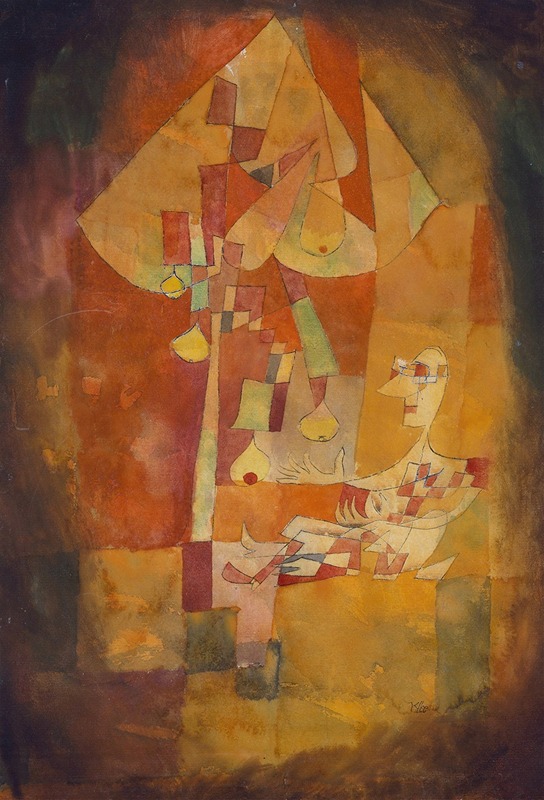
Art: Paul Klee, “The Man Under The Pear Tree”, (1921)