In which I discuss how we should live.
The path we have been walking together has not been easy and promises to be more difficult still. Fair warning, dear reader: this is the longest chapter in this book and it is too long to be read in email. Please read this post in your browser or the Substack app to finish the chapter.
Having learned first how to think (see chapters 2-7) and then what to think about (see chapters 8-13), the alien, our proxy in these endeavors, must now decide what exactly to do about what they have discovered. As our investigation of the phenomenology of time in chapter 13 has shown us, as temporal beings with wills, we are forced to make choices, act upon them, and then live with the consequences. And we don’t live with those consequences alone…our choices affect others, the choices of the people of the past affect those of us in the present, and the choices we make today affect those people who will live in the future. We change the world by making choices and then everyone must live in the world our choices made. The past won’t let go. Thus it is immensely important that we make the right choices, so I now wish to explore exactly how to do so.
It is sometimes said that the first question of ethics is “how should we live?”. Please notice the use of the word “should” in this question. “Should” implies what is called a “normative claim”…it says that things should be a certain way and that if they aren’t that way something abnormal is happening (for good or ill). If we accept this question as the first question of ethics, then we may also say that the first question of political philosophy is “how should we live together?” It is to these questions which the alien now turns their attention.
In modern anglophone philosophy, there are three primary schools of ethics.
Deontological ethics, such as that put forth in the work of Immanuel Kant. Deontological ethics justifies normative claims in terms of duties and the abstract principles related to the actions taken, rather than any concrete consequences associated with those actions. When people claim that “we should do x because it is the right thing to do, regardless of the consequences”, they are making a normative claim using a deontological notion of ethics.
Consequentialist systems of ethics, such as utilitarianism, justify normative claims in terms of maximizing the outcomes that are considered the most beneficial. Different consequentialist philosophers have prioritized different outcomes, such as pleasure, but the key notion is that we should make our choices in such a way that the results of our choices maximize the desired outcome.
Virtue ethics, such as the system of ethics put forth by Aristotle in the “Nicomachean Ethics”, justifies its normative claims in terms of “virtues” and “vices”, which may be defined as “thick” ethical concepts which describe patterns of activity that are seen as praiseworthy or blameworthy in themselves. A “thick” concept is one that is both descriptive (it picks out specific features of the world, in this case specific behaviors) and evaluative (it implies that the features that it picks out are either praiseworthy or blameworthy, good or bad, desirable or undesirable, etc). There have been many proposed lists of virtue/vice pairs, but typical lists include virtues like courage, justice, and wisdom, which are opposed by the respective vices cowardice, injustice, and foolishness.
I wish to argue here that, of these three schools of ethics, the school most appropriate to mages and mystics is some variety of virtue ethics. First I will explain why I believe that neither deontological nor consequentialist ethics are useful or appropriate for practicing mages and mystics, then I will show why virtue ethics most suits our ethical needs, and finally I will show how virtue ethics expands to become a functional political philosophy when applied to ethical communities.
First, if we are to build any sort of philosophical system, we must first begin with our fundamental definitions and our basic axioms. Only once these are established can we then begin to reason about the issue in earnest.
First, I define the following terms:
The Ethical – The exhaustive and inclusive category of all ethical concepts and the continuous struggle to be praiseworthy in our world as we experience it. This notion includes our definitions of ethical terms, our base ethical intuitions that we accept as necessarily true, and the active work of ethical reasoning and considered action in the world. Please note that in my usage, the terms “moral” and “ethical” are used synonymously.
Person – A mind (note that this mind need not be human…spirits, deities, animals, plants, faeries, elementals…I accept all of these and more as people).
Ethical Agent – An agent is a person that acts upon another person.
Ethical Patient – A patient is a person that is acted upon by another person.
Praiseworthy – Ethical category and status denoting acts and agents of which we should approve.
Blameworthy – Ethical category and status denoting acts and agents of whom we should disapprove.
Duty – An act which an agent is ethically obligated to perform. Please note that some duties can be conditional.
Prohibition – An act from which an agent is ethically obligated to abstain. Please note that some prohibitions can be conditional.
Recalcitrant – A person who is completely unwilling, for whatever reason, to engage with the Ethical.
Ethical Opportunist – A person who habitually violates the Ethical while also habitually protesting when they are harmed by violations of the Ethical committed by other agents. These people share most or all of the ethical intuitions that inform our axioms, are able to make ethical arguments using those intuitions as building blocks, can effectively detect violations of the ethical most of the time, and can usually predict when an act will violate the Ethical, but experience little to no distress at violations of the Ethical that do not harm them and experience little to no compunction or remorse regarding their own violations of the Ethical.
Ethical Community – A group of people who owe each other some behaviors as duties and among whom some behaviors are prohibited. Typical examples of ethical communities are families, religious communities, and civic communities like towns, cities, states, and nations.
Next, what are our fundamental ethical intuitions, our axioms? I put forth the following and only the following:
Principle Of Fairness: People should get what they deserve. This is the most fundamental axiom and the basis of all ethical claims I will use in my work unless otherwise stated.
Principle Of Ethical Inclusion: All people whatsoever are both ethical agents and ethical patients. No one is above or below the threshold of the Ethical. It may be that some people are permitted more ethical latitude than others because of extreme youth, age, or impairment, but these are always exceptions to the rule and therefore always require special justifications. In all other cases, praiseworthy behavior is desirable and blameworthy behavior is undesirable, by definition.
Principle Of Ethical Motivations: The reasons why an agent commits an act are relevant to that act’s praiseworthiness or blameworthiness.
Principle Of Ethical Outcomes: The results of an agent’s act are relevant to that act’s praiseworthiness or blameworthiness.
These principles are the foundation of all of the ethical reasoning I will use in my work going forward unless otherwise specified. From these axioms, I:
Justify my normative claims as based on the notion of moral desert, the idea that by virtue of particular facts about ourselves, other people, or the world, specific people deserve specific outcomes and not others.
I assert that all people whatsoever are within the category of the Ethical. This means that no one, no matter how rich, powerful, or honored, is above the Ethical, and that no one, no matter how poor, weak, or dishonored, is below the Ethical.
I assert that people can’t be accidentally praiseworthy or blameworthy…outcomes can be accidentally beneficial or harmful, but most people, including myself, seem to hold the intuition that if one accidentally causes harm one is less blameworthy than if that harm was intentional and vice versa. I do not believe in moral luck. This does not mean that the consequences of one’s actions cannot be either beneficial or harmful and more or less desirable based upon that fact, and it does not mean that the agent responsible for causing benefit or harm is necessarily not to be held responsible for their actions or the harms that they cause. I am only claiming that if someone commits an act while convinced reasonably by all the available facts that their choices are praiseworthy and it surprisingly turns out that the act in question causes harm, those choices are not somehow rendered retroactively blameworthy. A common example is a qualified surgeon that is sober, well-rested, well-nourished, and healthy, who makes a specific decision during surgery that, according to all of their experience and expertise, should have been the right decision to make, but the patient dies anyway. By saying that I do not believe in moral luck, I am saying that I do not agree that the ethical status of the surgeon’s choice flips from praiseworthy to blameworthy when the patient dies…if it was praiseworthy when they made the choice and acted upon it, then it does not become blameworthy when the results of the act are felt. The good or bad luck of either the surgeon or the patient does not dictate the ethical status of the surgeon’s choice. The worst that can happen is a choice that would have otherwise been praiseworthy becomes blameless or neutral (see below).
I assert that, despite the fact that motivations are clearly ethically relevant, that outcomes are also ethically relevant. We care whether the surgeon in the prior example killed the patient or not, and we would not call their choice “praiseworthy” if that choice led to the death of the patient. At best we might call the moral status of the surgeon in the example “blameless” or “neutral”. Yes, I acknowledge that there is a tension between these two axioms, but I believe that we have to live with that tension as a brute fact of ethical life in order to maintain our ethical intuitions.
Of course, the difficulty with these axioms then comes in figuring out who deserves what and why and who intended what to whom for what reasons, and that becomes much of the practical work of ethics.
While it is true that many people have more definitions and axioms that they may wish to apply to the Ethical than this, I wish to use the fewest definitions and axioms possible because systematic complexity is often the enemy of systematic coherency. As we discussed in chapter 7, I believe that, when possible, we want our beliefs to “hang together”, to be at least consistent and coherent enough that we can use them effectively to understand ourselves and the world and to act accordingly. It is not necessary that our beliefs be perfectly logically consistent (please see chapters 2 and 6), because we are using a four-value paraconsistent logic where a proposition may be true, false, true and false, or neither true or false, but as both epistemic and ethical agents and as mages and mystics, we do want our beliefs to be able to be held together in such a way that they do not produce problems in either our understanding of the world, our engagement with the Ethical, or with our works of magick and mysticism. To these ends, I want to build our systems of beliefs to be as simple as possible without losing anything important.
Next, I will address the problems with deontological ethics and why I believe that it is unsuitable for mages and mystics.
Let us first examine an ethical problem from the past (but increasingly relevant today, unfortunately): let us imagine that you are a German citizen in Nazi Germany and you receive a knock at your door. You are asked by Nazi soldiers if you know of any Jewish people hiding anywhere in the neighborhood. You know for a fact that your neighbors are hiding a Jewish family in their attic, and you know for a fact that if the Nazi soldiers capture the Jewish family, they will be harmed. What should you do? Deontological ethics would say that, no matter what, one should always tell the truth. Different people would justify this choice in different ways, but generally the choice that deontological ethical systems would consider praiseworthy is telling the truth, regardless of the consequences. Now, is this right? Can we accept this notion of the Ethical? Is this not an ethical absurdity more deplorable than any logical absurdity? Can it ever be praiseworthy to turn a threatened and oppressed ethical patient over to the very ethical agents who intend to harm them? Does this not contradict our second ethical axiom, that all people are both ethical agents and patients and that no one is above or beneath the considerations of the Ethical? And how does the answer deontological ethics gives us fulfill the Principle Of Fairness? Do the ethical agents deserve to find and harm their ethical patients because of their legal authority? Do the ethical patients deserve to be harmed because of their ethnicity or religion? I think that the answers to these questions are no.
Now let us consider another problem with deontological ethics: from where do we get our principles? Immanuel Kant tried—with debatable success—to fix the Ethical in the logical. He said (more or less) that one merely needed to consider the abstract rule implied by any proposed act and then consider whether one could truly wish that rule to be universal. If one could not reasonably will that rule to be universal, then it could not be a rule that one should follow. Thus, since one cannot reasonably wish all communication to always be deception because this negates the very concept of communication (there would be no point in trying to communicate or receive the communications of others because every communication would always be false), according to Kant, one should never lie. But is this line of argument actually reasonable? I assert that it is instead the case that different situations require different approaches to ethics and that any ethical system that deals in absolutes is doomed from the start to failure. We live in a world where there are many ethical values that compel various duties and prohibitions…engagement with the Ethical occurs in the tensions between those values, the many different “goods” which each situation defines and towards which we wish to orient our actions. To try to render that process fixed and absolute, to mechanize it by reducing it to an algorithm, is to attempt to avoid the very struggle that is intrinsic to the phenomenological experience of the Ethical. It is to attempt to turn what is meant to be an affair of both the heart and the reason into merely an affair of the reason…and to do that is to step outside of the Ethical.
I will use another common example to argue my point. Let us consider Victor Hugo’s novel “Les Misérables”: Jean Valjean is released from prison, his original crime that of stealing bread for his starving sister and her family. His passport marks him as a former convict and he can’t find an inn that will let him rent a room, so he is forced to sleep in the streets. The Bishop Myriel takes him in, and Jean promptly robs him of his expensive silverware and runs for it, only to, just as promptly, be caught by the police. When the police take him to be confronted by the bishop, the bishop surprises everyone by telling the police that he gave the silverware to Jean, going so far as to press two more silver candlesticks into his hand, as if Jean had forgotten to take them. After the police leave, the bishop says that Jean’s soul has been purchased by God and urges Jean to take the money and use it to build an honest life for himself.
What would a deontologist tell us about this story? First, was Jean praiseworthy or blameworthy when he stole the bread for his starving sister and her family? The thoroughgoing deontologist would probably say that Jean was blameworthy for doing so, because according to the deontologist, stealing is always wrong. After all, if stealing was made the universal rule then that would negate the entire concept of property, the same way as if lying was made a universal rule then it would negate the entire concept of communication.
What about the actions of the bishop? The thoroughgoing deontologist would also probably say that the bishop was blameworthy when he lied to the police, because lying is always wrong (see above). But doesn’t this violate the Principle Of Fairness? Don’t Jean’s sister and her children deserve to eat? Doesn’t the Bishop Myriel deserve to be able to dispose of his property as he wishes? And what about the mercy of the bishop? Isn’t that act of deeply nuanced and situational mercy an ethically beautiful act, an act worthy of praise, regardless of whether such an act can be universalized into a rule that should apply to all agents whatsoever in all possible relevant situations? Isn’t that what mercy is? Isn’t mercy when the rules say you should punish someone and you forgive them instead? Can deontological ethics abide mercy? Put another way, are deontological ethics compatible with an ethics grounded in mercy? I don’t think that that they are.
And so it seems clear to me that deontological ethics, if allowed its universalizing way, produces ethical absurdities. By attempting to fix the Ethical in the merely logical, we lose the very essence of what we desire from the Ethical: that it actually leads to the outcomes that everyone deserves. This violates our first and most important axiom.
As mages and mystics, especially, I believe strongly that we should resist absolutizing systems such as those of deontological ethics, regardless of how comforting such absolutes may feel. Our realm has always been in the liminal, in the temporary tensions and the in-betweens. We necessarily live in the gray areas between light and dark, above and below, ouranic and cthonic…no, not just in the gray areas, we live in a world of colors, a wild and beautiful array of deities, forces, and spirits that evade classification, bleeding over into each other and blurring the lines between Self and Other, Subject and Object, Ideal and Actual, and Magickal and Mundane. In the realm of magick, all such dualities are unified and transcended. We have made lives out of building alliances and rivalries that bridge the eternal and the temporal, out of pursuing initiations that unmake and remake our very natures again and again, and out of working our wills in and upon a world that does not submit to absolutes. We are apes that touch the Divine, are transformed by that touch, and then go on to touch the world. The rigid shackles of deontological ethics are not for us.
Now let us discuss consequentialist ethics. While there are forms of consequentialist ethics that seek to maximize specific goods, such as hedonism, which argues that we should maximize pleasure, the primary form of consequentialism considered in modern anglophone philosophy is utilitarianism, which attempts to abstract the various goods we pursue in our lives to the general concept of “utility”, with a generalized goal which is generally understood to be “the greatest good for the greatest number”. Utilitarian ethics invites us to engage in a sort of moral arithmetic, an ethics of the balance sheet, where we add up all the total benefits of a given act, subtract all the losses, and the choice that ends up optimizing for the highest utility is the most praiseworthy choice, while any suboptimal choices are blameworthy exactly to the extent that they are less optimal than the most optimal choice. I see several problems with this system of ethics.
First, how are we to know the scales of possible optimization for utility in a given scenario when utility is so poorly defined as “the greatest good”? What is good for the bear is not always good for the fish, much less the oak tree. People differ. People’s needs differ. People’s situations differ. People’s agenda’s differ. And they often differ in kind, not just degree. So how can we add up all of these different “goods” and flatten them down to one good called “utility” and then maximize for that composite good which is not actually the good of any actually existing person but a composite of all of the goods? Is this not an issue of incommensurability, where two or more things cannot be compared because there is not a unit of measurement common to both?
Second, and on a related note, what is a utilitarian to do when two parties within the same ethical community have mutually exclusive goods such that if one agent pursues their “greatest good” successfully then another agent necessarily cannot pursue their own “greatest good”? How can mutually exclusive goods within the same ethical community be resolved? This is similar to the last criticism, because the issue is similarly a question of how do we abstract the various and often conflicting goods of various and often conflicting people in the same ethical community into a set of neutral costs and benefits that allows us to optimize for the best choice algorithmically? It is all well and good to attempt to cash this out in terms of “the greatest good for the greatest number of people”, but even that leads to moral absurdities, as we will see below.
Consider the following: a great number of people need organ transplants to save their lives, by which I mean that they require a specific organ in order to continue to live at all. In these cases, not just any person can donate a given organ…the donor has to be a tissue match for the person receiving the organ. So let us say that there are ten such people who each need a different organ and there is only one person who is available who has the right tissue match for all of them. Under utilitarian ethics, the proper answer would be that the single person donates all ten organs to the ten different people, even if it kills the donor. After all, once we start doing moral arithmetic, we have to assign values to things like lives, and ten lives being saved clearly maximizes utility compared to saving one life. And perhaps this might be permissible in extreme circumstances and if the donor was willing. In my opinion, that would be an ethically beautiful act, indeed. But what if the donor is not willing? Utilitarianism says nothing about freedom of choice, merely that one should make the available choice that maximizes utility. But can it ever be ethically praiseworthy to treat one person like a collection of spare parts for several other people, regardless of the donor’s will on the subject? And how do we address things like power dynamics, where what is good for certain people, like the wealthy and powerful, is often considered more important than what is good for the poor and marginalized? Can a system that will use some people up to build up other people ever truly be said to navigate the Ethical successfully? It seems to me that utilitarianism also violates our first and most important axiom: under utilitarianism, people do not get what they deserve, at least not reliably.
As mages and mystics, I also feel strongly that we should resist all forms of consequentialism, all attempts to flatten the vast variety of values that mages and mystics actually hold into a moral calculus that turns ethics into mere arithmetic. While utilitarianism is tempting in its simplicity and its clear solutions, just as deontological ethics is tempting and for the same reasons, this temptation is still the same unfortunate urge to flatten the struggle of the Ethical into the merely logical. Arithmetic will not let us sidestep the work of actually being ethical agents any more than logic will. We must still struggle with the Ethical, because the Ethical is lived through that struggle just as much as through its resolution. To reduce ethics to an algorithm is to evade the weight of the Ethical, and when we set aside that burden, blameworthy acts soon follow.
Which is what leads us finally to the school of ethics which I consider the only true candidate for an ethical system for mages and mystics: virtue ethics. Where utilitarianism and deontological ethics both attempt to sidestep the Ethical by reducing it into the merely logical, virtue ethics justifies its normative claims in actual ethical concepts: virtues and vices. To be virtuous is thus praiseworthy and to be vicious is blameworthy, full stop, locating the locus of ethics in the actual deliberative act rather than in either the abstract principles such acts are based upon (deontological ethics) or the utility of the projected outcomes of those acts (utilitarianism). It is also notable that within virtue ethics, virtue and vice are both modalities of behavior and evaluations of character. Similarly to ethical status terms like “good” and “evil”, to be virtuous is to “do virtue” and to be vicious is to “do vice”. Thus, as Aristotle argues in the “Nicomachean Ethics”, since virtue and vice are something we do that defines our moral status (whether we are virtuous or vicious defines whether we are praiseworthy or blameworthy), they are ultimately, like other things we do, matters of natural talent, training, development, and habit.
This is why I believe that virtue ethics is not only the best ethical system to which we currently have access, but I also believe that virtue ethics is the most appropriate and useful system specifically for mages and mystics. Like magick, the Ethical is something we do as well as something we are, which is why trying to ground either magick or ethics in the merely logical is doomed to failure. We don’t merely think the Ethical…we do the Ethical and we live the Ethical. To make my argument clear, I am saying that the Ethical is phenomenal—something we experience—and the Ethical is a techne, an art, craft, or skill—something that we do. This means that like anything else we do, ethics is something that we can do well or do poorly. Like anything else that we do, we can be talented or untalented at it, we can be better or more poorly trained in it, we can develop our skills within it to greater or lesser degrees, and we can build good or bad habits that help or hinder us in doing it well.
This is another strength of virtue ethics: it accounts for those who do not share our moral intuitions. While this reality pains me immeasurably, it is simply true that we share our world with people who do not wish to pursue the Ethical in any meaningful way, the people I call recalcitrants. They do not experience the distress that most of us experience when we witness or cause violations of the Ethical because, for them, it does not contradict their ethical intuitions. Deontological ethicists have tried to use logic to sidestep this issue, because even those who do not intrinsically share our ethical intuitions may still be convinced to pursue praiseworthy behavior and avoid blameworthy behavior through appeals to logic. Utilitarianism similarly tries to appeal to what seems like a reasonable assumption, that we all want to maximize “the good”, in an appeal to collective self-interest. But neither of these systems can truly account for why some people just seem to want to watch the world burn. They can’t account for why bad actors choose to act badly and don’t see why they shouldn’t. But virtue ethics explains the issue quite well: moral intuitions are just like mathematical intuitions…most of us share them, some of us are truly insightful and talented regarding them, some of us are untalented regarding them, and some of us just don’t seem to have them at all.
In college, I worked in the math lab for a while and I tutored a person who just couldn’t understand fractions, no matter what examples I gave, no matter how I tried to explain them. I tried using money, I tried using recipes, I tried using colored blocks, and they just couldn’t grasp it. They were not in any way otherwise impaired that I could detect and were able to discuss other topics quite intelligently and insightfully. They were also not innumerate…they could do arithmetic perfectly well, and had in fact worked in sales for several years before returning to college. Finally I realized they just didn’t have an intuition that “the total parts of a whole always total to that whole” that guided their mathematical reasoning. They just didn’t have that little thing in their brain that made them see how the parts come together to make the whole. Which meant that the best they could ever do with fractions was memorize the algorithms that would give the right answers…their mind would never put together the parts to make a whole naturally. They would never see why the answer was correct, but they would get the right answers, and that just had to be good enough. This meant, of course, that they also had problems when they got to factoring, but that’s a different story.
The point of this anecdote is to show that someone can be perfectly intelligent, have no other detectable problems with their cognition whatsoever, share all the other normal mathematical intuitions, but still just not possess a specific intuition that seems natural to most of us. This just seems to be part of the variety within our species. Essentially, the argument of virtue ethics is that people that do not share one or more of our ethical intuitions are born “ethics-deaf”, the same way that some people are born “tone-deaf”. And if someone is ethics-deaf, if they just don’t share one or more of our ethical intuitions, they are impaired just as much as anyone who was born without sight or hearing. They are unable to perceive something that is basic to a part of the world that we all inhabit…the Ethical. Like the person I tutored, they can follow rules to sidestep the issue and get the right answers most of the time, but since they don’t actually see why the answers are right, if the rules fail them in similar ways to the ethical problems I used in my criticisms above, they won’t know the difference. They won’t have that little part of their mind say “that just can’t be right” so that they check their work and try again. They will do what the logical rules of the ethical system tell them to do and be blameworthy for doing so.
One could argue that this is exactly the sort of person for whom systems of ethics like deontological ethics and utilitarianism are meant, people for whom the Ethical must be fixed in logic because they cannot sense the Ethical innately through their intuitions. But this sharing of intuitions (of all kinds, not just ethical) is clearly a deeply varied set of traits across our population. Because of this, it seems to me highly unlikely that any “one size fits all” ethical system that attempts to produce ethical answers to ethical questions by applying an algorithm will ever truly be successful. It seems to simply be a brute fact about the world that people share some but not all ethical intuitions and that they seem to feel reactions to violations of those intuitions more or less strongly. Some people prioritize some intuitions but not others, especially the Principle Of Fairness (even most recalcitrants can recognize when someone else is being unfair to them and they know when they are being unfair to others…they just don’t care), and some people are only disturbed when they experience harm from someone else violating the Ethical but show little or no distress when others are similarly harmed. We have all seen bullies who delight in tormenting others but cry foul the moment the tables are turned on them. I call such people “ethical opportunists”…they are aware of the normal ethical intuitions and, if asked, would probably say they agree with them, but they experience very little, if any, distress when witnessing violations of the Ethical that do not directly harm them and experience very little, if any, compunction or remorse when their actions violate the Ethical.
When someone actually feels the weight of ethical intuitions in the sense that I normally mean, they are disturbed by violations of the Ethical, experiencing moral outrage at the unethical behavior of others and compunction and remorse concerning their own unethical behavior. These are basically emotional experiences—though they usually have cognitive content—and thus can’t act as guides to ethical behavior. Emotions, after all, can often be in error or manipulated by others. But such emotional reactions do act as indicators of participation in the Ethical. If someone shows no distress at witnessing a violation of the Ethical and experiences no remorse or guilt when they violate the Ethical, this is a good indicator that they do not truly share our ethical intuitions, even if they protest when they are harmed by violations of the Ethical and make appeals to the normal ethical intuitions to justify those protests. This lack of distress means that attempting to use logical rules to calculate the Ethical is unlikely to appeal to these ethical opportunists. Someone who doesn’t care if you get what you deserve as long as they get what they deserve doesn’t truly feel the bite of the Ethical and doesn’t truly agree with the Principle Of Fairness. If they possess any ethical intuitions at all, they have little to no real emotional weight and are thus unlikely to be motivational in their choices and actions.
So even though an agent that does not share our ethical intuitions can use systems like deontological ethics or utilitarianism to approximate true participation in the Ethical to varying degrees of accuracy, if they do not truly share our moral intuitions, they lack any real motivation to do so. They just have no real reason to care. This means that most, if not all, people who do not share our ethical intuitions will be either ethical opportunists who play at the Ethical like one might play at Chess (to win) or complete recalcitrants. They might make a show of following a ruleset that seems ethical so long as it benefits them, but they don’t actually feel the weight of the Ethical because they experience little or no distress at violations of the Ethical so long as those violations do not harm them personally.
This presents an unfortunate reality for the rest of us. Some fraction of our population, those whom I call “recalcitrants”, refuse to attempt to engage with the Ethical at all, but a much larger fraction of our population are ethical opportunists. They usually experience some distress at violations of the Ethical, at least enough to identify violations when they happen and to successfully predict most of the times an act will violate the Ethical. They know when they are violating the Principle Of Fairness and may even experience remorse at doing so. But the pleasure that they experience by benefiting from a violation of the Ethical outweighs their remorse and, if there are no other negative consequences for them, they may very well repeat violations of the Ethical. This sort of ethical opportunist is the sort of person for whom criminal justice systems are designed…people who require an external negative consequence for blameworthy acts to act as a deterrent against violations of the Ethical.
I am not contending that such people do not suffer for violating the Ethical…many people clearly do. Nor am I contending that there are not people who are actually mentally ill and feel compunction and remorse without having actually violated the Ethical. It is also the case that when someone loses status, even through no fault of their own, or are victimized in certain ways, they may sometimes feel a sense of shame and compunction even though they did not actually violate the Ethical. Victims of sexual assault, people who become disabled through age, illness, or injury, or people who find themselves homeless, for example, sometimes feel ashamed and may blame themselves for the harm to them that was caused by a violation of the Ethical by someone else. Compunction, remorse, and shame are emotions and emotions can be hijacked. That’s why these emotional reactions to ethically charged events are useful as indicators that something is wrong, but can’t actually be used to successfully navigate the Ethical. Our emotions are surely always telling us something, but they can’t be used by themselves to navigate reality. As mages and mystics, we know this. Every element is fulfilled by the other elements and taking any element in isolation often leads to error, thus Water cannot be used alone to navigate reality.
What I am instead contending is that by labeling compunction and remorse as symptoms of mental illness and then treating them with drugs and therapy even when actual violations of the Ethical have occurred, we have enabled ethical opportunists to take over the world. We treat compunction and remorse like they were a stomachache rather than like what they often are…sense data from our ethical senses. And we have come up with many excuses, thought-terminating cliches that allow us to dismiss valid confrontations regarding violations of the Ethical, such as “it was just a joke”, “boys will be boys”, and “it’s just business”, which function only to enable ethical opportunists to benefit from the Ethical without having to contend with the Ethical.
Think about every bully who screams bloody murder at the slightest sign they are being “disrespected”, even as they treat everyone else horribly. Consider every slimy capitalist who does their best to screw everyone else over, even as they take them to court to self-righteously defend their own interests. These people are ethical opportunists, ethical freeloaders, benefiting from a society built on ethical intuitions they barely perceive, much less follow. And then, rather than changing their actions when they feel unpleasant emotions such as compunction and remorse so that they are no longer violating the Ethical, these ethical opportunists often go to therapy and use medication to feel better. Magick and mysticism can be used in the same way, as the concept of “spiritual bypassing” picks out quite well. The result of this sidestepping of the Ethical through the dismissal of emotions like compunction and remorse is that relationships go unhealed, that wrongs go unrighted, and that violations of the Ethical cannot be repaired, all of which causes consequences in the lives of everyone involved, often far into the future. Everyone loses, even the recalcitrants and ethical opportunists.
However, the solution to the problems posed by the existence of recalcitrants and ethical opportunists can’t be an attempt to mechanize the Ethical, to render ethical judgments into algorithms and ethical acts into outputs rather than meaningful changes we are making in the world and in the lives of ourselves and others. We cannot simulate the Ethical. We cannot abstract away from the Ethical. The Ethical can only be engaged with, struggled with, and agonized over. All else is folly. And the attempt to do so, to degrade the Ethical into the merely logical, does not give any incentive to recalcitrants and ethical opportunists to engage with the Ethical in any meaningful way. All it does is flatten the Ethical in such a way that it becomes meaningless for the rest of us. It defangs the Ethical and makes it a matter of calculation rather than actual moral effort.
Virtue ethics, however, retains the varied ethical poles we actually experience, maintaining the active and relevant ethical and emotional tensions between the specifically ethical categories of praiseworthy and blameworthy rather than collapsing them into the tension between logical and illogical, and—most of all for our own community of mages and mystics—virtue ethics transcends the dualism of deontological and utilitarian ethical systems.
Dualistic systems render values that should be what I call “bumpy” into values that I call “flat” (I will explore these concepts more in my forthcoming work). What I mean by this is that when we actually question ourselves or others about our values, we usually have a lot of them and they motivate us to various different degrees and in different ways in different situations. Different people relate to us in different ways, different things are more and less important to us, and we value these people and things in ways that are more or less continuous…our concerns usually flow smoothly into each rather than having jagged discontinuities. It is only when we have two or more conflicting values that we are tempted to engage in the sort of ethical dualism that mechanically divides all acts into dualistic categories of one dimension such as “good or evil”, “praiseworthy or blameworthy”, “desirable or undesirable”, etc, creating discontinuities and flattening all of these “bumpy” values into one “flat” value. This drastically simplifies ethics but it loses a lot of relevant information because, rather than recognizing the simple fact that in different situations and involving different agents and patients, the same act may be considered both praiseworthy and blameworthy, it attempts to cash out all ethical possibilities into only two discontinuous categories. This inevitably means that relevant ethical information and possibilities are lost as we “zoom out” and lose resolution. As in most things, context and who is doing what to whom matters…deleting that information from an ethical system just leads to ethical errors where everyone involved intended the best but still caused harm.
Throughout my work, I have been very clear about privileging relations in my metaphysics and relationships in my phenomenology, and one reason that I do this is to avoid the inevitable loss of information that occurs when we attempt to examine any fact or idea in isolation from the complex web of facts and ideas with which it relates. It benefits us nothing to define 2 if we don’t relate it to 1 and 3 and thus the rest of the number line. It is only through relations that facts gain meaning and only through our relationships with ourselves, each other, and the world that we, as people, discover and create meaning. This means that any attempt to abstract away from complex ethical realities must be resisted. We must always be willing to deal with the complexity of real ethical situations. Systems like deontological and utilitarian ethics attempt to “zoom out” from the personal to the universal in an attempt to get away from the inevitable messiness of our contentions with the Ethical. We must resist this urge, for it is exactly in contending with the messiness that we discover ourselves and each other.
We have only begun to explore this subject and have only truly discussed three systems of ethics (deontological, utilitarian, and virtue) while leaving out systems like the “divine command ethics” and “karmic ethics” because of their questionable authority. While I believe in both the Divine and in karma, not everyone does, so an appeal meant to urge people to engage with the Ethical based upon those systems cannot be an universal appeal to engage with the Ethical. Obviously, any ethical appeal whatsoever won’t convince true recalcitrants; they can’t be convinced to engage with the Ethical, that’s what makes them recalcitrants. And people who are deeply concerned with the Ethical do not need to be convinced; at most their personal ethics may need correction or counsel. The people I am speaking to are thus those who share most, if not all, of our ethical intuitions and agree with my axioms, but, for whatever reasons, still habitually violate the Ethical. I don’t expect that any argument, no matter how cogent or eloquent, will convince the recalcitrants of the world to change their ways, however much I wish that philosophy or rhetoric had that power. What I wish to do here instead is to set out a basic model for ethics that will both fulfill our axioms and provide a basis for the discussions of ethics specifically pertinent to philosophy of magick that will be forthcoming in my future work on the topic.
Given this goal, there are three other reasons I wish to argue for virtue ethics as being specifically useful, appropriate, and important for mages and mystics.
First, virtue ethics differs in two very important ways from both of the other systems we have discussed. Virtue ethics is “polyvalent”, which means that it pursues several different “poles” or “attractors” that create access to multiple value combinations simultaneously that are sometimes in tension with each other and sometimes in cooperation with each other, and virtue ethics is “multidimensional”, which means that it has several different ways in which it measures the virtuousness or viciousness of a given act. There are several virtues (each with a corresponding vice) and each virtue is meant to be pursued in healthy relationship with all others rather than in isolation. In addition to this, each virtue represents a happy virtuous mean between two unhappy vicious extremes, where e.g. to be courageous is to stand balanced between the extremes of cowardice and foolhardiness. Thus, as opposed to both deontological and utilitarian ethical systems, virtue ethics assumes from the beginning that there are multiple ethical “poles” or “attractors”, each of which has its own requirements, and each of which lay in a continuum between two defining extremes. In addition to this, it is not enough to be wise or brave or caring, etc…one must pursue all of the virtues in an integrated way appropriate to each situation in order to truly be virtuous, which makes the system truly polyvalent. These polyvalent and multidimensional aspects of virtue ethics much more adequately reflect the actual nature of the Ethical as we live it and especially reflects the complex and nuanced worlds of magick and mysticism.
Even in monotheistic magickal systems, it is recognized that there are many different forces at work in the universe and within the person. An obvious example of this in modern “Western” occultism is the psychocosmic model called the “Tree Of Life”, which originated in the very monotheistic system of Jewish mysticism called Kabbalah. In this model, we see ten spheres, called the sephiroth, linked by twenty-two paths, with each sphere representing a primary concept and the paths linking the spheres showing the relations between those concepts. Learning to navigate and work with all of these spheres and paths is the initiatory work of many different traditions of magick and mysticism, and in these systems the apprentice magician is usually warned of the dangers of imbalance, of pursuing or avoiding any sphere or path in particular, because to become imbalanced in this way is to invite both spiritual and personal disaster.
Similarly, many modern traditions of witchcraft use the pentagram as a psychocosmic model, with each point representing one of the five magickal elements and the lines representing the relations between those elements. Also similarly, the initiatory work in many systems of witchcraft follows the pentagram and similarly those apprentice witches are warned about being balanced in their relationships with each of the magickal elements and that imbalance courts disaster.
These models are thus also polyvalent and multidimensional, presenting multiple combining elements that are all equally defining to the whole system and which each present their own continuum of expression possessing independent dimensions of extension. Each of these models are also continuous. The paths of the Tree Of Life and the lines of the elemental pentagram have no breaks, with each concept connecting to the other smoothly through a specific defined relation. Please note that despite how it may seem, the Abyss/Daath is not actually a discontinuity on the Tree Of Life, as those who have crossed it will attest. In a very real sense, Daath is equally continuous in its connection with every other sephira…the Abyss is always just one step away.
Very simply, virtue ethics more adequately corresponds to the sort of polyvalent and multidimensional models used in magick and mysticism than the single ethical dimensions and monovalent orientations presented by deontological ethics (whether or not one is fulfilling one’s duties, enacting valid principles, etc) or utilitarian ethics (the expected utility of a given act).
Second, virtue ethics are idiosyncratic, exuberantly creative, and elaborative, rather than reductive and abstracting. The virtues are not a “one size fits all” ethical solution. Virtue ethics does not present an algorithm where you feed in facts and it outputs what to do. Each person must explore the issue for themselves and deal with each virtue/vice pair on its own terms. Each person will have their own ethical talents, their own places where they need to do work to various and deeply idiosyncratic degrees, and they will need to build and break various different good and bad ethical habits so that they will still engage properly with the Ethical even when they are annoyed, tired, or otherwise impaired. People come up with new lists of virtues and vices all the time and there is no systematic desire to have as few virtue/vice pairs as possible or to have one virtue/vice pair capture and express as many possible ethical behaviors as possible. In fact, the longer one pursues virtue ethics in their lives, the more likely it is that their personal list of virtue/vice pairs will change many times and that their personal relationships with each of those virtues and vices will change a great deal.
Similarly, magick and mysticism are idiosyncratic, exuberantly creative, and elaborative, rather than reductive and abstractive. While we love our systems of correspondences, our various psychocosmic models, and our spells and rituals, rather than working towards simplification and abstraction in these models and practices like the physical sciences have, we tend to create endless innovations and variations, building on the works of others who have come before us and then going off in wildly novel directions. It was very apt when Aleister Crowley defined magick as both a science and an art, because like a science it seeks to understand and influence the world, but like an art it is endlessly creative and personally transformative.
It is also common for the same mage/mystic to engage in this same ongoing work of endless elaborations and creativity over the course of their own career, creating extensions and revisions of their own work over their own lifetimes, inventing novel applications and solutions, and sometimes learning new traditions and systems and/or creating their own. We often become our own teachers, breaking away from our structures and routines every few years to rebuild ourselves in new and experimental ways.
Even our primary pedagogical model, that of the teacher and student, assumes that every one of us are going to add our own insights and original work to what we teach our own students. First we learn and grow and then we build upon the work of those who came before us and go our own way, to share our insights and create our own innovations. The pattern of magickal life is often bound up in the cycle of nature: we are born into magick, we grow, we die, we are reborn, and then we grow again. Thus virtue ethics fits our ethical needs more adequately than deontological or utilitarian systems, because each of our personal systems of virtue ethics can grow, die, be reborn, and grow again with us.
Finally, virtue ethics invites us to be our idiosyncratic selves in our ethical lives rather than inviting us to think of ethics like we think about math problems. Both deontological ethics and utilitarian ethics, at least in theory, should always give the same answer to the same ethical problem, without regard for the idiosyncrasies of the agents or patients involved. But I have already established in chapters 5, 10, and 12 that:
All of our knowledge is necessarily situated. It always comes from some point of view and all of it is necessarily understood only within the context of the particular relations and relationships in which that point of view participates. As epistemic agents (people who gain, produce, reproduce, and use knowledge), we can never possess a “God’s eye view from nowhere that sees everything”. (please see chapter 5: Situated Knowledges)
Each object is defined as a nexus of possible relations that give rise to its possibilities in the world. Since no two objects can exist in identical relations simultaneously, this means that all objects are necessarily unique. (please see chapter 10: Metaphysics)
Each subject is defined as a nexus of relationships, which are relations that are subjectively experienced and give rise to the experience of the self. Since no two subjects can exist in identical relationships simultaneously, this means that all subjects are necessarily unique. (please see chapter 12: Notes On The Xeno Position)
Given these three previously established conclusions, how can we accept an ethical system which promises us generalized, “one size fits all”, algorithmic ethical solutions that care nothing at all about the actual ethical agents and patients involved? Such a system does not—and cannot—speak to needs of particular individuals and communities for the justice and care they deserve, especially since it is only particular individuals and communities that actually exist. There is no such thing as a “generalized” or “abstracted” person or community. Every person and community is necessarily particular and idiosyncratic, with particular and idiosyncratic ethical needs and particular and idiosyncratic ethical outcomes of which they are deserving. If we make ethical systems that only provide idealized and abstracted solutions for idealized and abstracted ethical agents and patients that don’t actually exist, then who are our ethical systems for, exactly? And mages and mystics and our communities tend to be even more deeply particularized and idiosyncratic than average non-mages. Our minds are filled with resonant (please see chapter 8) symbols, each of which are uniquely meaningful to each of us. Virtue ethics is the only ethical system that allows us the sort of particularity that actually fits our needs, both as people and as mages and mystics.
Given all of this, it seems we have answered the first question of ethics. The answer to the question of “how should we live?” is “we should live virtuously”. So how we do adapt virtue ethics, a system of ethics that is naturally particularized and suited to individuals, into a system of political philosophy meant for ethical communities? How should we live together?
First, I think that we should resist the urge to attempt to generalize away the particularity of virtue ethics. This particularity is a strength, not a weakness. Instead, I believe that our political philosophy should speak to individuals in the ethical community in terms of civic virtues and civic vices. We sometimes act ethically as members of groups, but groups cannot be virtuous or vicious, only individuals can, which means that we must always locate the locus of ethical agency (and thus responsibility) in the individual. Each and every individual still has a duty to pursue virtue and avoid vice, regardless of the actions of the other agents in their ethical community.
To define civic virtues and vices, we must ask a new question that is implied by the Principle Of Fairness: “What do we deserve from each other?” By answering this question we can orient our prospective list of civic virtue/vice pairs. I put forth the following answers to this question. Please note that this is a minimal list, meant only to act as a beginning for more discussion.
As ethical agents, people deserve the right to their own agency, which means the right to freely deliberate upon and enact their own choices and to then live with the consequences of those choices. This means that self-determination is a civic virtue and authoritarianism is a civic vice.
As ethical patients, people deserve the right to live free of fear that they will be unnecessarily harmed, exploited, or limited by other ethical agents. This means that peacefulness, mutual defense, and self-defense are civic virtues, while bellicosity (being aggressive and warlike as a policy), toxic individualism, and passivity in the face of obvious common threats (a collective form of cowardice) are civic vices.
As members of an ethical community, people deserve to flourish. This means that education and community engagement are civic virtues and ignorance and isolation are civic vices.
As members of an ethical community, people deserve a minimum amount of care, including food, safe housing, emergency care (firefighters, paramedics, law enforcement, etc), healthcare, and social inclusion. This means that mutual care is a civic virtue and that toxic individualism is a civic vice. Notably, toxic individualism is paired as a civic vice with two different civic virtues, mutual defense and mutual care, but the reality is that the term “toxic individualism” captures a wide variety of behaviors and I wish to be as specific in this list as possible.
Given this provisional list of civic virtue/vice pairs, I believe that the ideal virtuous ethical community would have to:
Favor collectivism over individualism. Members of ethical communities are owed a duty of mutual care and mutual protection from each other that supersedes their duty to serve their own individual interests. If the Principle Of Fairness is to be preserved we must recognize our interconnection and recognize the limitations of our own legitimate self-interests.
Maintain individual rights in the face of collective desires. If the Principle Of Fairness is to be fulfilled, the urges of collectivism must always be balanced by duties to self like self-care, self-fulfillment, and self-defense.
Invest more heavily in the welfare of the members of the ethical community than in military adventurism. If the Principle Of Fairness is to be fulfilled, the fiery and martial energies of aggression must be redirected into fulfilling the needs of the members of our ethical communities and helping them flourish. Rather than trying to make our enemies less, we must try to make ourselves more.
Of course, this model of a political philosophy based upon civic virtue ethics is only a sketch. My goal here is merely to present a way that our engagement with the Ethical might be thoroughgoing in both our personal and political lives. I believe that an unreasonable distinction has been made between the personal and the political and the values and expectations applied to each. Many people who would never dream of committing violence against anyone in their personal lives still vote for war hawks who promise military adventurism all over the world. Many people who volunteer their time and labor for charities and community programs still vote for politicians who promise to cut social welfare programs. Many people bemoan the fact that our societies are falling apart while still constantly pushing to cut taxes and defund and privatize education. I wish to question and argue against this strange estrangement of the personal and the political that (just coincidentally) seems to predominantly favor the most vicious bad actors while leaving the most vulnerable among us to suffer. We must be willing to actually put our money where our mouths are, to actually pay our taxes and volunteer our labor, to actually educate our children even if that means they may defy our wishes and become more difficult to control, and we must do the hard work of actually holding ourselves and each other accountable to the Ethical. In order to do all of that we must deliberately pursue the Ethical in both the private and public spheres and do so in an integrated way that recognizes that the Ethical transcends any perceived distinctions between public and private or political and personal. In the immortal words of feminist activist and essayist Carol Hanisch: “The Personal Is Political”. We must act accordingly.
We must become virtuous.
And with that, I conclude our longest chapter. Next comes the conclusion.
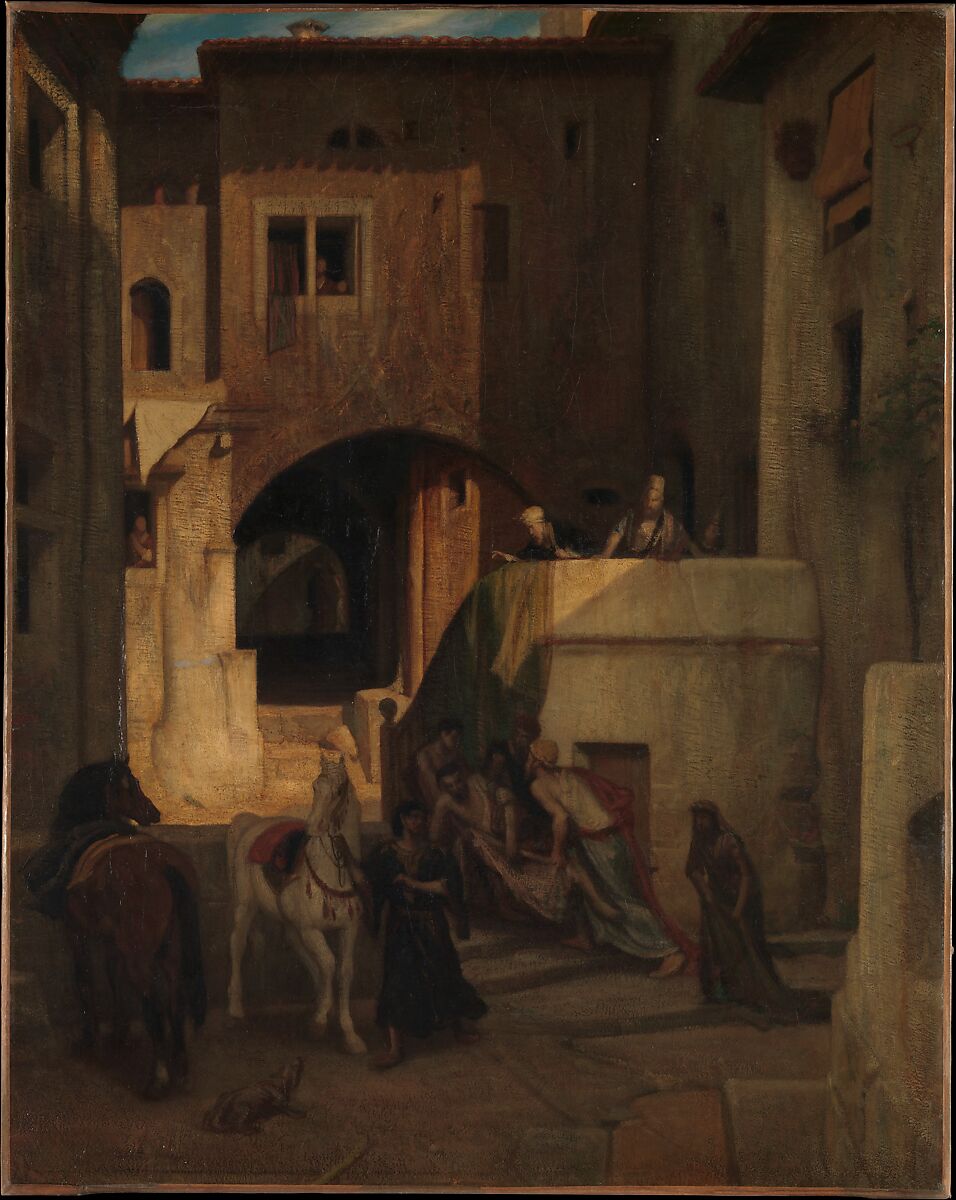
Art: Alexandre-Gabriel Decamps, “The Good Samaritan”, (1853)