A homily for the Full Moon on December 4, 2025. Written, as always, without authority.
Dearly Beloved,
Blessed Full Moon, dear ones. I greet you in the name of Aphrodite and the name of the Divine on this, the Full Moon of Sagittarius.
I am sure the topic of this homily is puzzling to some of my readers. I am, after all, a very vocal anarchist (I was an anarcho-syndicalist for a very long time, now I am an anarcho-socialist, more or less) and an even more vocal critic of the US government and the entire notion that any government can ever be legitimate in any real sense.
But, dear ones, I am still very much a patriot.
My political awareness started young, thanks to my Grandfather, whom I have spoken of many times before (and will again). I was taught that loving my country had nothing to do with the government and everything to do with how we treat each other and the values that we work to uphold in our lives. So early as age 21, I was already working for various activist causes such as Food Not Bombs and Feed The People. I would work at the feedings and then eat my meal after everyone was done and we cleaned up. As I got older, I became more heavily involved in labor issues via the Industrial Workers Of The World. These are very much my two pet issues: food and labor. And the reality is that the US government has often been on the wrong side of those—and many, many other—issues.
But I love America. Not the America it is or has ever been. Not the government or its ever-increasingly pathetic and criminal presidents. Instead, I love my dream of the America that could be. My Grandfather’s dream. The dream that led him to serve for 20 years in the US Air Force and then another 20 years in the US Postal Service. The dream of an America that actually repairs the harms it causes, avoids the harm it can, and takes care of all of its people. The America I have been trying to build since I was a homeless teenager watching the kids sitting next to me at the drop-in center slowly die from meth and heroin because they were hopeless, heartbroken, and desperate to feel anything except cold. Anything except hungry.
Anything except alone.
I ended up homeless at 16 mostly because I became too much of a problem for my biological mother and her family (and they became too much of a problem for me, frankly). I was on the streets, mostly in Victoria, TX, New Orleans, LA, and Santa Cruz, CA, until I was 19. I was—am—nothing special. My Dad was the special one. He was a legend to me then, the larger than life, brilliant, and popular witch, artist, and musician I wouldn’t meet in person until I was 23. But me…well, I was just another gutterpunk playing guitar on the sidewalk for quarters. Thin from perpetual hunger and generally ridiculous, I wore the scars on my wrists, smudged eyeliner, and drugstore dye-job like trophies of war rather than the 90s cliches they were.
Like I said, nothing special.
I wandered the streets of downtown Santa Cruz each day, walking dutifully alongside my teacher as he rolled along in his wheelchair and waxed philosophical. He instructed me in the values and traditions that became the foundations of my adult life. Along with the normal lessons of a beginner ceremonial magician, I was schooled on everything from the works of Hermann Hesse (Tony was especially a fan of “Demian”…he had all three of us read it) to the music of St. Hildegard Von Bingen, Type O Negative, and The Tear Garden.
My teacher often teased me—his nickname for me was “Lord Bombast” (this was pre-transition by many years)—because of my tendency for making rousing speeches and proclamations to anyone who would listen to me for more than five minutes. But he often warned and lectured me about my little talent, as well, because he was reasonably concerned about the uses to which I would put it. He knew all about my history in Texas, about the vampire cult and its aftermath. He knew that I could rally people to a cause—even a very, very bad one—and that I could lead them when I chose. But he also knew that I was deliberately refusing to lead anyone after that horrible experience, which often frustrated him as well. He wanted me to be a leader. He saw it in me. He also just didn’t want me to be steered around my whole life by guilt, which is still a struggle. But I had learned a terrible lesson about the power of my words, and that lesson frightened me into volunteering to play follower to one “best friend” or romantic partner after another. I became very good at being the right (well, let’s be honest, left) hand of other people who I trusted to call the shots.
I spent many years like that, and I consider them years very well spent. I learned who, why, and how to follow, which also taught me a great deal about what made someone a good leader. I also learned—at great personal cost—about bad leaders and why I must be very discerning about who I follow. I’m not going to name any names, but I’m sure that those of you who knew me in my 20s can think of a particularly bad leader I followed, a charismatic man with whom I built a business, a polycule, and a life, and with whom I eventually parted ways over how he was behaving. But even with that man at his absolute worst, the lessons I learned during that time were still good, and the most important lesson I learned was how to make myself small so the mission can be big, which has served me well every day of my life since.
It was during those middle years that I began to reconsider the lessons of my Grandfather. In my teens and into my 20s, I saw all of the weird militaristic parts of my childhood as abuse, as my Grandfather trying to violently retain some sense of purpose as his body and mind began to fail him. My struggles in my teens just seemed to confirm that point of view. Look at how fucked up I was! Look at how I ended up a homeless punk, panhandling on the street! Clearly it was due to my abuse.
But at the same time, while I was homeless all of those things my Grandfather taught me paid off again and again. I knew how to live rough. How to assess and respond to threats. How to make and carry out plans. How to build and maintain a camp. How to secure resources. How to use and maintain tools and weapons. How to administer first aid and assess the sick and wounded for further care. And, most importantly, I knew how to protect my first wife, the first adult relationship of my life and the mother of our daughter who went up for adoption. All of this, thanks to my Grandfather and his—ahem—unique training program.
It was while I was reviewing the influence of my Grandfather upon my life that I began to think that maybe, just maybe, the whole concept of “patriotism”, at least the way my Grandfather had lived it, was not as stupid as I had thought. As the cynicism of youth faded and I grew into true adulthood, I began to realize that there actually are values and people worth fighting for. Worth dying for. Worth much more than dying for.
Worth living for.
Now, a lot of moral philosophers, especially those writing after WWII, have had a rather poor opinion of the partiality of patriotism. Many have argued that, just as our sources of scientific knowledge need to be objective and impartial (readers of my philosophical work know that I think this sort of objectivity is impossible), our ethical considerations should be just as objective and impartial. John Rawls famously argued in “A Theory Of Justice” (Belknap Press, 1971), for the “Original Position”, which presents an excellent argument that we should build an ethical world by both making the rules democratically and by making them from behind a “veil of ignorance” where we don’t know who we are each going to be in the world that we help create. This is supposed to motivate each person to work towards making a world that will be just and equitable for everyone.
I think that, like all notions of impartiality and objectivity in general, this is a great idea that would work wonderfully for an entirely different sort of creature than humans. Perhaps this sort of system would work admirably for the pseudo-AIs that the techbros seem obsessed with forcing upon us. But since humans are, by their very nature, invested creatures that are defined primarily by having lived concerns and felt needs, the sort of creatures that live naturally within networks of kinship and care, this sort of objectivity in ethics is meaningless for us. Worse than meaningless, the entire idea is misleading because it misplaces where our concerns must be centered in order to be oriented towards any particular behaviors at all. While I should always be ethically concerned with all people and their welfare, the people with whom I can meaningfully act upon those concerns are those with whom I actually share a life. My wife. My family. My community.
My country.
I care deeply about Palestine. About Ukraine. About Afghanistan. I have written and spoken upon these issues in various places. But I live here. With my wife. And my family. In the country that my Grandfather served for most of his life. Where my Father lived and died. Where every person with whom I have ever shared a bed or built a life has lived. Where my six year old niece lives. Where my daughter, her spouse, and her family lives.
I’m not saying my country is good. It’s broken. It was always broken and it remains broken not by accident or necessity, but by design. These are facts. It sprouted from corrupt seeds, was tended with stolen labor, and grew in bloody soil. Its fruit has most often been bigotry and oligarchy. It is systematically racist, sexist, homophobic, and transphobic. Its culture and politics are greedy, arrogant, and warlike. Its leaders have consistently and almost universally made bad choices, caused unnecessary harm, and wasted the lives of devoted people who only wanted to serve their country. I have read our history, I have learned our laws, and I have looked at our leaders, and I weep and rage by turns.
And it’s my home.
It’s my home, and I want to make it better. I’m not willing to give up on it. I love my country and I am willing to work hard to make it worthy of that love.
I know some of you reading this have reasonable and just complaints against the leaders and people of the USA. I do, too. But this homily is not about the USA. That’s just an accident of who happens to be writing it and where I happen to live. I could just as easily be writing this in any of a hundred or more countries. This homily is about patriotism, and I think we should all be patriots. We should all love our homes and want to make them better. I am a patriot, and I want the Russians to be patriots, the Chinese to be patriots, and the MAGA people to be patriots, too. True patriots, who want what is best for their country and their people.
All of their people.
And while I do want my home to be the absolute best it can be, I don’t want that to come at the expense of anyone else. This isn’t some kind of weird competition or zero-sum game, or at least it doesn’t need to be. My neighbor having less food does not actually give me one ounce more food. That person panhandling on the corner being homeless doesn’t help me keep my home. Other people being poor doesn’t help me one bit. That’s not how any of this really works. We have so much food the stores throw it away to keep the prices up. Houses and lots are kept empty to keep real estate prices high. Corporations and politicians all collude to create the illusion of scarcity to continue to justify their own existence, power, and wealth. This Playground, as my teacher called it, has more than enough to go around.
We just have to actually pass it around.
And let me be clear: even if this supposed scarcity were real, I believe that it would still be right to choose to help others. While I am only a Christian in a very obscure and technical sense that almost no other Christian would ever acknowledge as valid, I do believe that I am called by the Divine to love my neighbor (and everyone is my neighbor) and to make sure they get fed. I did it all the time when I was homeless. You would be amazed how good half of a baloney sandwich and half of a carton of milk can taste when it is shared.
The truth is that my thriving is bound up with your thriving. Your concerns are my concerns. All the gods are family, and we are family, too.
So let us remember that our communities—our neighborhoods, cities, states, countries, and world—need not be a constant kaleidoscope of horrors. Let us remember that we can choose, at any moment, to cooperate instead of compete. To care instead of count the cost. Let us remember that we can resist the siren songs of selfishness and fear. That we can, at long, long last, finally grow up.
That we can be patriots.
Blessed Full Moon, dear ones. May all of the blessings of the gods be upon you in the next two weeks.
In love,
Soror Alice
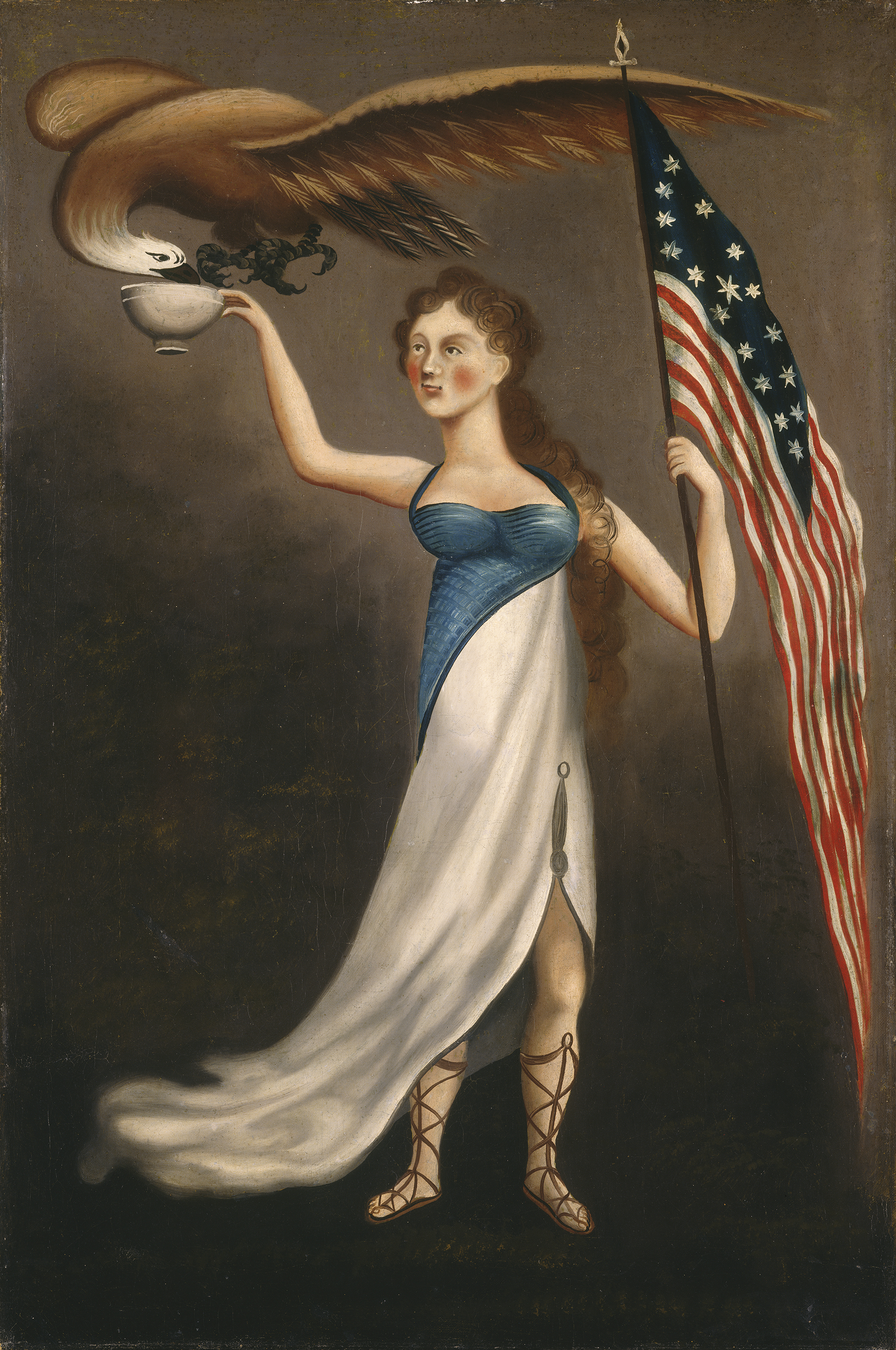
Art: Unknown Artist, “Liberty”, (~1800-1820)
Beautifully put. Thank you.
I’m glad it spoke to you, Nico. Thank you for reading.
Ah, I love this (and your heartfelt but dignified honesty, as ever). I am a citizen of not one but two desperately broken polities and yet I have such a deep love for the ideals and the potentials of the United States and the Repubblica Italiana that I often wonder if it’s a kind of codependency.
But codependency really relies on a studied willingness to not see, and if I ever had that capacity I lost it way back in the Reagan years (and again in the Berlusconi era). The flip side of codependency (or maybe its dark shadow) is philophobia, and political cynicism is both easy (because merited) and enervating. I am not a citizen of Utopia. I live here, now, and my son will grow to adulthood here (or, if circumstances warrant, there). My wife often says “he’ll grow up seeing how bad things are, but he’ll also see us trying to make it better.
My countries, right or wrong: if right, to be kept right; if wrong, to be set right. (Cit.)
Blessings to you on this Gemini moon, soror and commander.
(good lord that is a lot of parentheses)
I’m so glad it spoke to you, Paul.
🫡
Good one. I’ve been thinking of Rawls recently. The kinship point is helpful. I worry about tribalism as it drives people apart, yet kinship is more flexible. I trust you have street family. I do. I was out there as an adult. I moved a long ways away, and still on the move in a sense… it seems I should write about more of this. Thank you for the inspiration. Have a good moon.
I’m so glad it spoke to you, Kevin. Thank you for your kind words and thank you for reading.
Wow this brought a tear to my eye. after a long military career and then ideologically falling away from the Army’s agendas in Afghanistan, I still love America. yes, I agree wholeheartedly that there are so many ways to be a patriot that does not have to fit the coca cola and apple pie mold. I got some real stephen king classic novel american neighborhood feelings reading this.
Thank you, Solomon. I am so happy it spoke to you.
Thank you for your service. It means so much. And thank you for reading.
Alice. So much of your post resonated with me. I can be a patriot and a bleeding heart liberal (or equivalent). I appreciate your substantive and in depth exploration and explanation of what can be a controversial topic. As I’m nearing 80, I have lost my ability to formulate a complete and accurate explanation of topics I care about. this is frustrating but I’m willing to take time to look things up to help me pull my thoughts together rather than give up. And I’m taking piano lessons which I believe is helping to build new neural pathways in my brain.
I have 6 granddaughters and 4 great granddaughters. My youngest granddaughter lived with me for 4 years. She is 18 and loves to explore deep thoughts. I’ve asked her to explore and put in writing her thoughts on a topic that has intrigued me. I would like to ask you to do the same as I love where your mind goes. The question I’ve pondered is considering how early humans evolved. Initially individual survival was our primary focus as it still is in many ways for sentient beings. However, as we continued to evolve connection and community led us to not only survive but to grow and develop, to become more. The whole is greater than the sum of its parts. I asks her to research the balance between those who live in survival mode and those who maintain connection and communication as primary.
This tension seems relevant today in the US as we seems to be living in survival – isolation, shoot first and ask questions later – cutting off relationships – etc. I’m curious what you think about this particular dilemma.
With love, blessings & respect – San
Thank you for your comments, San. I know when you approve of my work I am doing good things.
I will consider your question. It is a good one. I will probably answer it as an essay, homily, or polemic, as I am a “serious person” as Alex calls me and I take such questions seriously to want to answer them justly. It might make a good Yule homily, honestly. Thank you for the idea.