An essay on magick, mysticism, and living the spiritual life. Written, as always, without authority.
In part 1 of this series, I explained what I mean by theiatry and what I mean by Ζένη and the Xeno Position. Now I want to go into more depth about what these words are and what they mean both to me personally and how they relate to the system of initiation within which I have been working for 29 years. The goal of this is to help contextualize my work and what I am trying to accomplish going forward. This is a complex and often deeply personal topic, and I always want to be honest with all of you and to speak clearly. I also want to lead with my vulnerability and to speak from my heart. Finally, as anyone who knows me personally will attest, I want very much to be understood.
The system of initiation within which I have worked for most of my life is that of the A.’.A.’., a magickal and mystical order officially founded in 1907 by Aleister Crowley and George Cecil Jones. The grade which I have taken is known as “magus”. A magus is a mystic who has been inspired to proclaim an aeonic word, which is a new magickal and mystical formula, a new modality or way of interacting with both the world and with the Divine.
Many magi have existed throughout history. Crowley and the official doctrine of Thelema claims that only a single aeon exists at a time, that they last for centuries or millenia, and that, as of Crowley’s reception of Thelema in 1904, the aeon of the “Dying And Reborn God”, sometimes called the “Aeon Of Osiris”, has been supplanted by Crowley’s “Aeon Of Horus”. Crowley’s terminology and statements on this topic were complex and he varied over the course of his life on how many aeons be believed there have been and who the magi of history have been. As in many things, he was inconsistent. The introduction to Liber AL says that there have been only three aeons, with the third being the current Aeon Of Horus, but elsewhere, in Liber Aleph, Crowley says that there have been many magi, including Jesus, Siddhartha Gautama (the Buddha), Muhammad, and Lao Tzu.
In a foundational document for the A.’.A.’. called “One Star In Sight”, Crowley says that while there can be many magi at any given time, that they all sublimate their own aeonic words to the current “Word Of The Aeon”.
He says:
“A Magus can therefore only appear as such to the world at intervals of some centuries; accounts of historical Magi, and their Words, are given in Liber Aleph.
“This does not mean that only one man can attain this Grade in any one Aeon, so far as the Order is concerned. A man can make personal progress equivalent to that of a “Word of an Aeon”; but he will identify himself with the current word, and exert his will to establish it, lest he conflict with the work of the Magus who uttered the Word of the Aeon in which He is living.” – Aleister Crowley, “One Star In Sight”, (1929)
This seems…very wrong. Anti-Thelemic, even. Very authoritarian. Very monotheistic. Very “One God, one Lord, one faith, one church, one empire, one emperor”. Very exclusionary of anything outside the dubious inheritance of “Western” civilization. Crowley thinks that one man (notice his use of the word man throughout all of this, the casual assumption that only men can be magi) gets to define the spiritual lives of an entire planet for centuries, if not millennia. That one relationship between one person and the Divine dictates terms for all of reality.
And I think that’s bullshit.
The Buddha proclaimed his aeonic word, which Crowley says is “Anatta (Atman)”, ~500 years before Jesus proclaimed his word of “Agape”. The Buddha’s word has influenced the spiritual lives of billions of people since then, for thousands of years. That didn’t stop when Jesus, Muhammad, or Crowley came along, and it’s still going strong.
Muhammad proclaimed his aeonic word, which Crowley says is “Allah”, about 600 years after Jesus proclaimed “Agape”. His word has influenced the spiritual lives of billions of people for over a millennia since then. His word wasn’t somehow sublimated or subordinated to that of Jesus. The spiritual formula of the “Dying And Reborn God” didn’t somehow define Islam. Islam didn’t fall away when Crowley pronounced “Thelema”, nor did Crowley submit himself to Muhammad’s word of “Allah.” Crowley had his own experience, received his own insight, and proclaimed his own word, just as Muhammad had before him and Jesus had before him.
Frankly, Crowley’s notion of how aeons and aeonic words work is Eurocentric and colonialist. It reflects the workings of Empire, of power and domination, more than any spiritual reality that is actually true to the lived experiences of humanity as a whole. Crowley was brilliant, highly accomplished, inspired by divine forces…and a rich white 19th century Englishman who literally thought he was the next messiah. He wanted to believe that he was one of a kind, or at least one of only a few famous and important people. And that incredibly fragile sense of self, that wounded child that so many of us can see at the heart of his writings, especially his “autohagiography”, needed very much to believe that he was one of the most special people in all of history, the Beast of Revelation that his mother called him, rather than just one of many magi who have influenced—rather than ruled—the spiritual lives of some of the people of the world, which is what any reasonable examination of the facts attests.
The Temple Of Set, for all that I disagree with so much of their doctrine and worldview, has a much clearer—and frankly less Dispensationalist Christian— view. They hold that aeonic words exist in dialogue with each other. This is how they have been able to grow and change as new magi have come up within their ranks. As a new magus proclaims their word, the ToS as a whole adapts to include the new spiritual formula. This is much healthier than attempts by any one magus to dominate an entire era and is a move towards the sort of horizontal power structures that one would think Thelemites, as a rule, would desire.
But I want to argue that even that is not enough. The motto of the A.’.A.’. Is “The Method Of Science. The Aim Of Religion”, and while I know too much about philosophy of science to think that is strictly possible (how do we get a p-value for something like “getting my ex who is stalking me to leave me alone” so that we can show empirically and inductively that our magick had an effect?), I do think it makes sense to use abductive reasoning (reasoning to the best available explanation) to explore the notion of aeonic words.
Crowley experienced a specific mystical experience that led him to an understanding of what an aeonic word is, and he mushed that together with the dubious theology of his Plymouth Brethren childhood to produce his theory of aeons as periods of time. I want to argue instead that that the insight provided by Liber AL and Crowley’s actual mystical experiences—and the experiences of other magi such as Nema, Michael Aquino, Don Webb, etc—is that aeonic words, words which define a formula for doing magick, mysticism, and pursuing the spiritual life, exist. I think that, barring some exceptions of magickal and mystical traditions that don’t believe in the concept of aeonic words at all, we can all agree on that. And that is a big deal, all by itself. The fact that aeonic words are a thing is definitely important.
But now I want to put forward an idea that comes from the logician within me: words are usually parts of sentences and sentences are usually meant to convey meaning. And I want to take this idea one step further: the meaning of any given word is partially defined by the context in which it exists. Except for a few exceptions—usually imperatives like “Stop!” and “Now!”—words require other words and structures of multiple words—sentences, paragraphs, and so on—to give them meaning at all. This is a variation on W.V.O. Quine’s famous “Gavagai” argument from his work on the indeterminacy of translation (W.V.O. Quine, “Two Dogmas Of Empiricism, 1951): words need to be situated within a “web of meaning” created by other words in order for us to know what they mean. Without that web of meaning, a word by itself is just a noise or a scribble on paper.
Meaning is relational.
This means that it is probably an error to think that only one aeonic word is in effect at a time, for centuries if not millennia. Those aeonic words would lack context by being isolated from other aeonic words. It also means that we can’t actually hope to understand Anatta (Atman) or Agape or Allah or Thelema (or Ζένη, for that matter) in isolation. We have to try to think about them as parts of a message that is unfolding itself over time, with each aeonic word clarifying and giving context to the whole as the message unfolds.
To be clear: I am arguing for a pluralist, relational, and cooperative theory of aeonic meaning rather than a singular, objective, and authoritative theory of aeonic meaning.
This sort of relational meaning even happens within the work of a given magus. Crowley’s aeonic word is Thelema, but there is another word, Abrahadabra, which defines the Great Work in relation to Thelema. In a sense that has been used in modern occultism, Abrahadabra is the other pole to Thelema in an energetic “current”. In the same way, the word “Θεἰατρεία” (Theiatry) is the other pole to “Ζένη” (Xenē). While Ζένη (Xenē) is my actual aeonic word as Θέλημα (Thelema) was Crowley’s, Theiatry is the mission while Xenē, the Xeno Position, is the method of operation. They are an interdependent pair and both can only function properly with the other.
This all gives us a larger puzzle, of course. There is a message, or perhaps many messages, being spelt out, one word at a time, by these aeonic words. What is it? What is it for? Who is it coming from?
Here is where I will conjecture a bit. One of my closest friends—who also happens to be one of the best mages I know—thinks that aeonic words are proffered solutions to the general problems of human existence. Basically the gods sent a message via Aiwass to Crowley as a way of saying “Damn, you humans are fuuucked. Maybe I can help. Try this maybe?”. Under this explanation, the gods sent me messages via my HGA (no, you don’t get to know their name; Crowley can tell people stuff like that if he wants, but I don’t kiss and tell) that ushered me towards my own solution.
I agree with this in principle. My only addition is that I don’t think that each aeonic word taken alone is a proffered solution. I think the whole message is the solution. I was trained in the Hermetic Qabalah, so I think of it as messages in bottles, thrown by the Divine into Marah, the Great Sea Of Binah. The bottles are small (I don’t know why, but clearly they are), so they only contain one word (which often inspires a holy text, or in my case a verse of a poem) at a time, but when we put enough of them together in the right order and use them together in the right way, we will be able to puzzle out how to save ourselves.
To be clear, this is not a mysticism of transcendence. I do not believe the message is about how to get out of manifested reality. I no longer see manifested existence as a problem to be solved or transcended. Yes, sorrow exists. So does joy. Why does the former get to define our spiritual lives while the latter is dismissed or ignored simply because it is not absolute and eternal? The sorrow isn’t absolute or eternal, either, why does it get to dictate terms? Why pursue a mysticism based on quitting the game when it’s a pretty damned good game? Why not just work on improving the game where necessary and the rest of the time just enjoy the game for its own sake?
Maybe that’s the part of me that’s still a Thelemite talking. I do believe that existence is joyful. I just don’t agree that it is “pure joy”. Clearly suffering exists, and any theology or mystical system that doesn’t account for suffering in an honest and meaningful way is incomplete. We can transcend that suffering by transcending the self in favor of the Self by using mystical practices, shifting over to the big Divine version of us that doesn’t need or want anything. That does work. You can do that. But that seems a great deal to me like throwing out my prime rib dinner just because it was served with pickled beets (I loathe pickled beets). Sure, a given incarnation may be particularly bad and it’s very hard to pursue joy while enslaved and exploited, but, at the absolute worst, that only justifies ending that particular incarnation (or just not trying that hard to continue it). Reincarnation is a thing, or at least I have enough primary and secondary evidence that it is a thing to not be particularly worried about dying. I’m a gamer…dying is just an opportunity to catch my breath, do maintenance tasks like leveling up and repairing my gear, go talk to my friends around the game hub (in our case, the Underworld), and then head back out to start my next run.
That may sound immature, but trust me, seeing existence as a game (specifically a roguelike roleplaying game with management and social game elements, like “Cult Of The Lamb” or “Hades 2”) has made me relish it a great deal more. The “Wheel Of Samsara” just becomes the game loop. It stops being a burden and becomes enjoyable. Desirable, even.
Let’s all have fun and play together!
However, as a gamer I also want to make progress in every run I make. I want to make myself a little bit better prepared every time I start a new run, consolidating the gains from one cycle while moving on with joy and enthusiasm to the next. And that is where I think that aeonic words come into the mix. I think that the message about the rescue mission is not to rescue us from the world, but to rescue the world from us. Aeonic words are here to tell us how to fix the ship while we are on it. A ship that we definitely broke. And by us, I don’t just mean humanity. I mean the whole family…us, the spirits, the deities, all the way up the ontotheological chain to Chaos Themselves.
The first Hermetic Axiom on the Emerald Tablet asserts that:
“That which is below is like that which is above and that which is above is like that which is below to do the miracle of one only thing.” -Emerald Tablet, Sir Isaac Newton Translation
This says simultaneously that reality is holographic (the structure of each individual element mirrors the structure of the whole system) and holistic (all of reality is relationally unified, a single reality). So nothing happens in isolation. No one is really alone. This axiom also means that if things on the spiritual levels of reality change, things on the physical levels change, and vice versa. That’s why it’s the first Hermetic Axiom, the first axiom of magick itself, because it is the axle upon which the whole wheel turns. We do magick by manipulating symbols and our own consciousness on our level of reality, which causes corresponding changes in the spiritual level of reality, which in turn echo back to us as the results of the spell.
But this holographic and holistic structure of reality has consequences. Everything is connected. All of this started in the beginning when the gods went to war with each other (by gods here I mean the general category of all divine beings). This, as an event on the spiritual levels of reality, reverberated throughout the world of each person on an individual level and led to ages of constant wars and conflicts. If the divine forces that provide the structure and the ontological foundations for our experienced reality go to war with each other, we experience that on personal, social, and historical levels. While I think the notion that the age ruled by Cronus was actually some sort of “golden age” for humanity is probably leftover propaganda from the war between the Titans and the Olympians, the reality is that these wars on the spiritual levels of reality do affect us and there have been consequences to the actions of the gods.
If you come from a Christian perspective, you also know this to be true. The spiritual event of the War For Heaven has defined so much of what life on Earth is like. When Lucifer and His angels staged their rebellion, they set the stage for the current spiritual situation for humanity.
I’m not saying that conflict was not justified. To return to using the Greek mythical language to which I am accustomed, what Ouranos did by locking away the Cyclopes and Hecatoncheires was wrong. Gaia was trying to protect Her children when She enlisted Cronus and His siblings to fight back. But this was a moral failure on all people’s parts. Everyone is blameworthy. Ouranos should have accepted His children, regardless of how Their bodies were formed. He should not have been more afraid of their power and appearance than of failing to love them. Gaia should have used Her power as a Primordial to hold Ouranos accountable in a way that wasn’t about power and dominance but instead about remedying the toxic attitudes and behaviors while still honoring Him as Her partner. Cronus and His siblings should have taken an active and supportive role in this process of accountability and healing rather than going to war.
Let me be clear: Gaia and Cronus were reacting to brutal and authoritarian oppression of difference, and violence might be justifiable in such cases. However, Cronus didn’t actually remedy the situation at all when He took power. Rather than rescuing His siblings from their imprisonment, Cronus deposed His father and took His place, then started eating His own children to protect His newfound power. Then Zeus did the same thing to Cronus and the Titans, deposing Cronus, dividing up the world with His brothers, and building His own dynasty on violence in the same way as His father had before Him.
As before, I want to make clear that I am quite aware of Neoplatonism and Hermeticism. I am myself a committed metaphysical idealist, as I argue for in my own philosophical work. I agree completely that deities are principles of existence and that as such they actually are the metaphysical structures and principles that hold reality together at the seams. Absolutely. 100%.
I just also believe that they are people, too.
I know that’s very much out of fashion in ceremonial magick. People love the notion of “archetypes in the collective unconscious” and “forms/eidolons” and I will tell you why: it’s embarrassing to say that the gods are people and that we can have personal relationships with them. It sounds too much like Christianity, for one thing. How many of us have been accosted by Evangelical Christians ranting about having a “personal relationship with Jesus”? I’ll bet it’s a lot. Too many. But it also sounds “primitive”, too anthropomorphic, too unsophisticated, and for very good reasons modern pagans are touchy about being considered “primitive”. Calling pagans “primitive” has been used for millennia to justify atrocities against us. So a lot of modern pagans will jump up quickly to explain that they don’t actually believe that Aphrodite (for example) is a person with whom you can actually have a conversation, who will answer you when you properly call, comfort you when you are ill, and bless you with abundant love in all parts of your life. But I assure you that it is true. Give it an honest try sometime. Give some offerings. Sit with Her for a while. See what happens. Dream incubation is a great tool for those who have problems “seeing” and “hearing” spirits, as is both scrying and trance work. Take your time. Stick with it. I assure you, She’s worth it.
But I think that there is another reason that so many modern mages prefer a psychological or Neoplatonic paradigm over the magickal realist paradigm, one that many mages are loath to admit: it’s a lot easier. Archetypes in the collective unconscious and the forms/ideas of Neoplatonism don’t ask anything from you. Not really. They don’t expect anything from you or hold you to a standard. They don’t surprise you. They don’t send you on quests and assign you labors. They don’t ask you to do weird things. They just show up as symbols in dreams and sit there like the laws of mathematics…supporting all of reality impartially and disinterestedly. I’m sure the heroes of myth, people like poor Heracles, Odysseus, and Achilles, would have very much appreciated deities that were nice safe logical abstractions. But the actual myths say they got people instead and suffered for it.
Archetypes and platonic forms/ideas don’t tell you in a dream to sell everything you own and get a one-way bus ticket to New Orleans to begin your lifelong mystical quest, for example (which longtime readers will know is exactly what happened to me) and have it turn out to be true. I followed a trail of synchronicities and small mystical experiences across the country, met my teacher randomly while in line for a homeless feeding, and have since pursued a 29 year career in magick and mysticism. Archetypes and platonic forms can’t make that happen. They can’t make the exact right person, the fated person, the man who would change my life, stop to talk to me, a random homeless kid waiting in line for a sandwich and carton of milk. But an angel (by which I mean a divine messenger of a deity) can. In fact, according to the testimony of myths, holy texts, and actual mystics alike, that is exactly the sort of thing that angels do.
Crowley wasn’t tapped on the shoulder and dictated Liber AL by a logical abstraction. The gods that speak through Aiwass in Liber AL want things, do things, they have beliefs and desires. They aren’t just math. They aren’t just quaint placeholders for philosophical concepts.
They are people.
I don’t want to tell anyone what to believe. I know that plenty of mages—especially Thelemites—are very committed to certain positions about the things I have said here today. But I’m not going to pretend like I don’t disagree anymore. It is no longer my job to “tend the Garden” and I am not subordinate to any other magus anymore. I have my own aeonic word to worry about, my own message in a bottle, and that’s my mission now.
So while I am saying that I am a magus, I am not saying, as Crowley did, that I am the magus of the current aeon or something like that, because I think empirical evidence says that that isn’t how aeonic words actually work. I am simply presenting a magickal and mystical current, the Xeno Current, which is defined by the formula of the word Ζένη. This current has two poles: the Xeno Position, which is the method, and Theiatry, which is the mission. If the Xeno Current resonates with you, if you too wish to heal the family of the gods, I warmly invite you to join me in pursuing it. If not, if you wish to pursue Thelema, Agape, any other current, combination of currents, or no aeonic current at all, I encourage you to do so and would not have it any other way. In this way I am very much still a Thelemite: do what thou wilt shall be the whole of the Law.
I claim no power to define the spiritual formula of our age or to define anyone else’s spiritual life, nor would I want such power. By announcing that I am a magus and pronouncing my aeonic word of Ζένη, I am claiming that I have had a true spiritual insight—that I have received one of the messages in a bottle from beyond the Sea Of Binah—and that I am now setting myself to the work of acting upon it. While I would love for you to join me in healing the family, I would never try to force it upon anyone.
I have characterized my entire extant body of work on these topics with two words: “without authority”.
I stand by them.
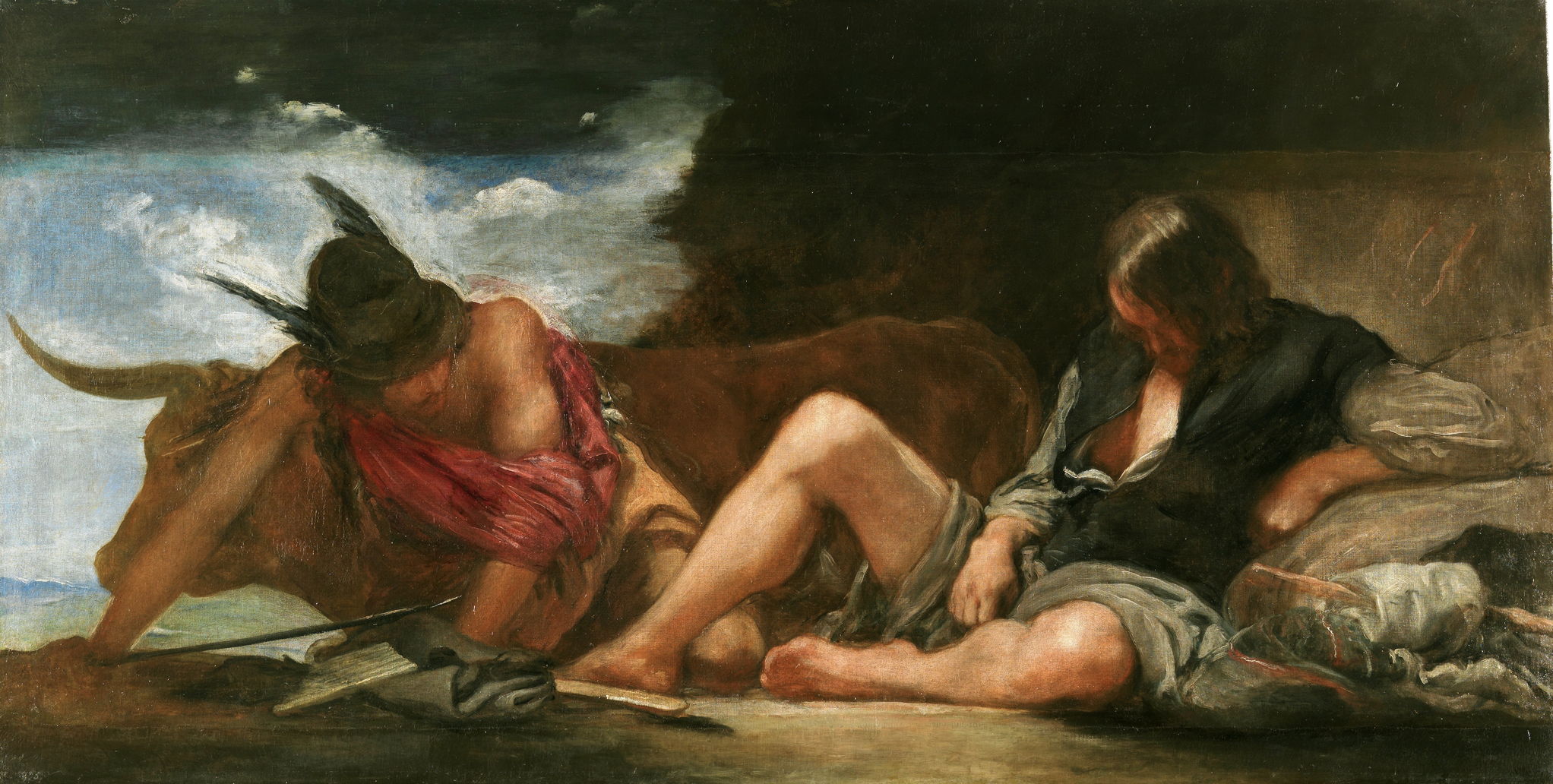
Art: Diego Velázquez, “Mercury and Argus”, (1659)
Wow!
This is a major Work.
It’ll require more than one read-through to even begin to grok this.
I’m very sorry, I tried very hard to be as clear and understandable as possible. If you have any questions please feel free to ask.
You were very clear and understandable. I will nonetheless save it and read it multiple times to really immerse myself in these ideas because you make very, very good points ! I just discovered your Substack thanks to the Cunning Farmer share and I’ll subscribe right away 🤭🥰
Ah, Cunning Farmer is awesome!
And thanks for the subscription!
I’m sorry this came off as a criticism. It’s simply a topic that touches me so deeply that I know I have to go deep to start to wrap myself around it.
I like things that make me go deep.
Ah, okay, I understand now.
I’m autistic and it’s hard for me to read people’s intentions. Thank you for explaining. It helps a lot.
I just read How God Becomes Real by the anthropologist Tanya Luhrman, in which she details all of the ways religious people cultivate relationships with the divine in their lives until it becomes real. She spent a lot of time doing fieldwork among evangelical Christians, and I was familiar with many of the methods she discussed from my Christian background. Since reading the book, I have been interested in relating to pagan gods in my current practice as people, which is why I recently put Freyr and Gaia on the dining room table. Your discussion of this topic is very timely for me. Thank you 🙏
I am very glad that it spoke to you. This is the output of the work of my entire adult life and it makes me feel extremely vulnerable to say all of these things. It really helps to know that it’s speaking to people.
Thank you for reading!
This is excellent, thank you.
I’m glad it spoke to you.
Thank you for reading.