Homily for the New Moon on July 5, 2024.
“Well, I went to the doctor,
I said, ‘I'm feeling kind of rough’,
He said, ‘Let me break it to you, son’
‘Your shit's fucked up.’
I said, ‘My shit's fucked up?’
‘Well, I don't see how,’,
He said, ‘The shit that used to work?‘
‘It won't work now.’” -Warren Zevon, “My Shit’s Fucked Up”, 2000
Dearly Beloved,
Happy New Moon!
This month I am in a liminal space in my own spiritual life. As the song says: my shit’s fucked up. And the shit that used to work? It won’t work now. So this New Moon, a time of endings and beginnings, I am moved to speak of the temporary tensions, the in-betweens, the liminal spaces, a subject that fascinates me even as it terrifies me (as any reader of my poetry can attest).
As I endlessly repeat in these little letters to our community: as pagans we believe in a naturalized theology. We believe that we can see the Divine in the features and processes of the natural world that surrounds us and of which we are a part. As participants and co-creators, we engage with nature and nature engages with us, and within that engagement we find meaning. So what does nature teach us about the liminal?
The truth is that in nature we see liminal spaces all over the place. Indeed, it’s almost impossible to find in nature a single state of affairs that is at rest and truly static. The Earth itself is both spinning on its axis and orbiting the Sun, and at the most fundamental levels of reality lay the arcane secrets of quantum indeterminacy. All of nature sings of flux, of change, of the constant rhythmic tides of beginnings, middles, ends, and new beginnings, and we are a part of it all. It’s truly breathtaking to realize that at every moment we are living in relation to all of nature and that we, as a part of nature, are also always changing. In a sense, we are the persistent thing under the changes we undergo, the mind, the point of view, the subject. But in another sense that notion of persistence is an illusion, subject and object are unified in the real, and all that remains are the changes themselves and the meaning disclosed by those changes.
Sometimes we meet these changes with joy. Each day I greet the dawn with a hearty “Hail unto Thee who art Ra in Thy rising!” and I try to cultivate that joy in the rising Sun, the growing warmth and light, that is appropriate to the occasion. But many times I fail…I am tired and my eyes are squinting and I just want to go back to sleep. I try to meditate on the rising Sun and I end up just meditating on my bed.
Other times, it is about the pain of letting go of the thing that is changing, that is falling away, that is becoming different. The growth of darkness is the vanishing of the light, and though we believe that the light will return and even honor the darkness while it is here, it is often very difficult to let go of that shining light each day, each month, each year. It is sometimes hard to remember that the darkness is the seed of the light, and that both darkness and light are sacred.
But despite these difficulties, or perhaps because of them, the New Moon gives us a moment to honor the darkness and to anticipate the return of the light. The night of the New Moon is dark and the shadows are deep, holding wisdom and secrets. There are lessons to be learned—and friends to be made—in the dark.
So let us honor the temporary tensions, the in-betweens, the liminal moments between the end of one cycle and the beginning of another. Let us honor the Moon, hidden deep within the shadow of the Earth. And let us honor each other as we go through our own changes, as we each fall through our own shadows and come out the other side.
Happy New Noon.
With love,
Soror Alice
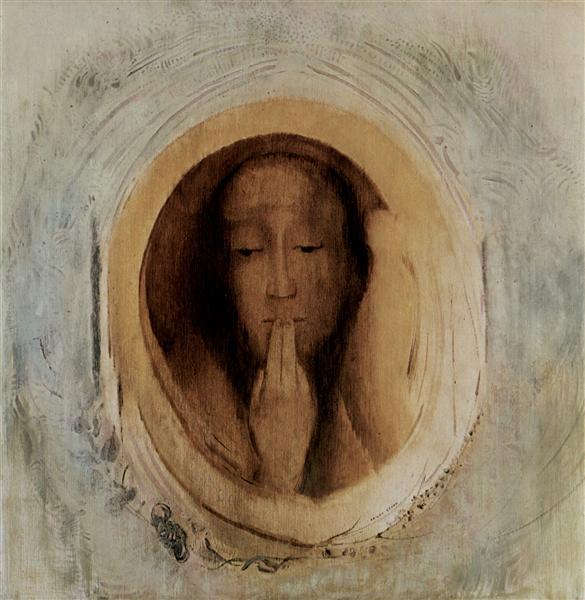
Art: Odilon Redon, “Silence”, (1900)